Smartphone Prices in India 2026 — Why They Are Rising and What You Can Do About It
Smartphone prices in India 2026 are at the highest level ever recorded — and every Indian buyer is feeling it. If you have been shopping for a phone recently and noticed that the same budget you had two years ago no longer gets you what it use to — you are not imagining it. Smartphone prices are increasing in India at the fastest pace in recent memory. The average selling price of a smartphone in India crossed ₹25,000 in the first quarter of 2026 — up 10.4% from the same period in 2025. The sub-₹10,000 segment has effectively collapsed, with shipments falling 59% year over year as phones in that price range became too underpowered to be worth buying.
This is not one company raising prices to make more profit. Every brand — Xiaomi, Samsung, Vivo, OPPO, Realme, OnePlus — has increased prices across their lineups in the past 12 months. The reasons why smartphone prices are increasing in India are multiple, interconnected, and largely outside the control of any single brand. This article explains every factor clearly — from the global AI chip shortage to the rupee’s depreciation against the dollar — so you understand exactly what is happening and what you can do about it.
Reason 1 — The AI Supercycle Is Driving Smartphone Prices in India 2026
The direct result is that smartphone prices in India 2026 have risen 10.4% year on year according to IDC Q1 2026 data.
This is the single biggest reason smartphone prices are increasing in India right now — and it starts thousands of kilometres away from any Indian smartphone factory.
The global rush to build AI data centres — by Microsoft, Google, Meta, Amazon, and hundreds of smaller companies — has created an extraordinary demand for advanced semiconductors. AI training requires massive quantities of high-bandwidth memory chips, advanced logic chips, and the latest processor nodes from TSMC, Samsung, and SK Hynix. These semiconductor manufacturers have finite production capacity. They can only make so many chips per month.
When AI companies began booking enormous quantities of chip production capacity — offering premium prices to secure supply — the manufacturers shifted their fabrication lines accordingly. The result is a global shortage of the chips used in everyday consumer electronics including smartphones — not because demand for smartphones fell, but because the manufacturing capacity was redirected to the higher-margin AI business.
Samsung raised prices on its DDR5 memory chips by up to 60% in 2025. The same memory chips that go into every mid-range and flagship smartphone. Every phone manufacturer — from Xiaomi to Apple — is paying significantly more for the RAM and storage in the phones they build. That cost increase flows directly to the price you pay at checkout.
Xiaomi specifically addressed this publicly, stating that the AI supercycle triggered an industry-wide surge in memory costs. The company, which sells phones under the Xiaomi, Redmi, and POCO brands and holds approximately 15% of the Indian smartphone market, confirmed this cost pressure as the primary driver of its recent price increases.
This is not a temporary disruption. The AI infrastructure buildout is a multi-year programme. CyberMedia Research’s Vice President of Industry Research described it as a “multi-year upward bias in pricing” — meaning smartphone prices will not return to their earlier levels even after this specific cycle of AI expansion slows.
Reason 2 — Rupee Depreciation Is Pushing Smartphone Prices in India 2026
Every smartphone sold in India — even the ones assembled here under the Make in India programme — depends on components sourced globally in US dollar transactions. Chipsets from Qualcomm and MediaTek are priced in dollars. OLED display panels from Samsung and BOE are priced in dollars. Camera sensors from Sony are priced in dollars. Even the screws and speaker mesh in budget phones are often sourced through dollar-denominated supply chains.
The Indian rupee depreciated approximately 4.15% against the US dollar through 2025. India imported smartphone components worth $7.15 billion in the financial year 2025 — with 51.7% of those components sourced from China. When the rupee weakens against the dollar, every dollar’s worth of imported components costs more rupees. This cost increase has to be recovered somewhere — and it shows up in the retail price of the finished phone.
For a phone with $50 worth of imported components, a 4% rupee depreciation adds approximately ₹170 to the import cost. Across a full phone lineup with millions of units, this adds up to hundreds of crores in additional procurement costs that brands pass on to buyers.
Rupee depreciation is not new — it is a structural feature of India’s economy as an import-dependent consumer electronics market. But its compounding effect alongside the chip shortage creates a double pressure on prices that makes 2026 uniquely expensive for Indian smartphone buyers. This currency pressure is one of the most consistent drivers keeping smartphone prices in India 2026 elevated beyond what component costs alone would justify.
Reason 3 — 18% GST Adds to Smartphone Prices in India 2026
The Goods and Services Tax on smartphones in India is 18% — unchanged since April 1, 2020 when it was raised from the previous 12% rate. This 18% applies to every smartphone sold in India regardless of brand, price segment, or whether it was manufactured domestically or imported.
The practical impact on a buyer is straightforward. A phone with a base price of ₹15,000 carries ₹2,700 in GST — making the actual payment ₹17,700. A phone with a base price of ₹25,000 carries ₹4,500 in GST — making the total ₹29,500. The GST does not appear as a separate line item in most retail purchases — it is baked into the listed price — which makes buyers unaware of how much of their payment goes directly to the government.
The GST Council reviewed smartphone GST rates at its 56th meeting in September 2025. The Council reduced GST rates on several consumer electronics categories — air conditioners and televisions were moved from 28% to 18%. Smartphones received no reduction — the 18% rate was confirmed unchanged.
Before the GST era, smartphones were taxed at 5% VAT plus 1% excise duty in most states — a combined burden of approximately 6%. The jump to 18% GST in 2020 was the largest single-year price increase in the history of Indian smartphone retail — adding approximately ₹1,000 to ₹3,000 to mid-range phones overnight. That increase was absorbed into current pricing and has never been reversed.
For fully imported smartphones — Apple iPhone, Google Pixel, some Sony models — an additional 20% Basic Customs Duty applies on top of GST for devices not assembled in India. This is why iPhones assembled in India (from iPhone 14 onwards through Foxconn’s Tamil Nadu facility) are significantly cheaper than the same models would be if imported fully assembled.
Reason 4 — Chipset Costs Have Risen Significantly Across All Tiers
The cost of the processor — the chipset — is the single most expensive component in a smartphone after the display. Chipset prices in India range from approximately $6 to $12 for entry-level 4G processors, $12 to $25 for mid-range 5G platforms, and $30 to $80 or more for flagship chipsets.
Several factors have pushed chipset costs higher across all tiers in 2026.
Advanced fabrication nodes — 4nm and 3nm — cost significantly more per wafer than older nodes. Wafer costs at these advanced nodes account for 50 to 60% of the total chipset cost. As every smartphone segment migrates to newer, more capable processors — 5G chipsets replacing 4G, AI processing cores added to mid-range chips — the base cost of the chipset rises.
Qualcomm and MediaTek spend 10 to 15% of total chipset cost on intellectual property licensing and royalties — costs that are embedded in the price they charge phone manufacturers. As chipsets become more sophisticated — integrating modem, CPU, GPU, ISP, and NPU into a single package — the IP licensing cost grows accordingly.
The migration to 5G across every price segment has itself driven chipset costs higher. A 5G-capable processor costs more to design, test, and manufacture than a 4G equivalent. The Indian smartphone market crossed 55% 5G chipset penetration in 2025 — meaning more than half of all phones sold now carry the more expensive 5G chipset. As this percentage grows toward the projected 85% by 2028, the average chipset cost across the total market rises accordingly.
Reason 5 — The Make in India Programme Has Limits
The Make in India initiative under the Production Linked Incentive (PLI) scheme has been genuinely successful in bringing smartphone assembly to India. Over 80% of smartphones sold in India are now assembled domestically — Samsung, Xiaomi, Realme, Vivo, and OPPO all have assembly operations in India. Apple assembles iPhones in Tamil Nadu through Foxconn and Tata Electronics.
Domestic assembly eliminates the 20% Basic Customs Duty on fully imported phones — a genuine price saving that benefits Indian buyers. However, the key word is assembly — not manufacturing. The components that go into phones assembled in India are still largely imported.
Chipsets come from Taiwan (TSMC), South Korea (Samsung Foundry), and to a lesser extent China. OLED display panels come from Samsung and BOE in South Korea and China respectively. Camera sensors come from Sony in Japan. Battery cells come largely from Chinese manufacturers.
Import duties on these components — not the assembled phones but the individual parts — create their own cost layer. Displays and batteries carry 10% import duty. The domestic semiconductor manufacturing infrastructure India needs to reduce this component import dependency is being built — India’s first semiconductor fab is under development — but meaningful domestic chipset production is years away.
Until India can manufacture chips domestically, every smartphone assembled here remains dependent on imported components whose costs are driven by global dollar-denominated supply chains, AI chip competition, and exchange rate movements outside India’s control.
Reason 6 — The AI Feature Tax
Smartphones in 2026 are required to do something that smartphones in 2023 were not — run on-device AI models. Every major brand has committed to AI features: Google Gemini on Pixel and Android broadly, Apple Intelligence on iPhones, Samsung Galaxy AI, and various on-device AI assistants across Chinese brands.
Running AI models on-device requires dedicated hardware — Neural Processing Units (NPUs) — integrated into the chipset, and significantly more RAM than previous generation phones needed. A phone that ran smoothly on 6GB RAM in 2022 needs 8GB RAM in 2026 to handle AI features without lag. A mid-range chipset in 2026 must include a capable NPU alongside the existing CPU and GPU, adding design and manufacturing cost.
This AI feature requirement is not optional — buyers expect it, and brands that do not offer it lose market share. The hardware cost of supporting AI is therefore baked into every modern phone’s price, regardless of whether you personally use the AI features.
What Rising Smartphone Prices in India 2026 Are Doing to the Market
The price increase is reshaping India’s smartphone market structure in real time.
The sub-₹10,000 segment — historically the largest volume segment serving India’s vast price-sensitive buyer base — has effectively collapsed. According to IDC data for Q1 2026, shipments in this entry-level segment fell 59% year over year. Its share of total Indian smartphone shipments fell from 18% to just 8%. The phones available under ₹10,000 in 2026 carry outdated chipsets that cannot run current AI features or popular gaming titles adequately.
The ₹10,000 to ₹20,000 mass-budget segment grew 10% year over year and expanded its share from 39% to 45% of total shipments. This reflects a forced migration — buyers who previously bought ₹8,000 to ₹10,000 phones now find they must spend ₹12,000 to ₹15,000 for equivalent capability.
Average selling prices crossed ₹25,000 — a record high for the Indian market. This premiumisation trend benefits brands’ revenue per unit but creates genuine affordability pressure for hundreds of millions of Indian buyers.
Practical Advice for Indian Buyers Facing Higher Prices
Understanding why smartphone prices are increasing in India is useful — but knowing what to do about it is more practical.
Buy during festive season sales. Amazon Great Indian Festival and Flipkart Big Billion Days in October remain the best time to buy any phone. Discounts of 15 to 25% on mid-range phones combined with bank card offers can effectively bring a ₹20,000 phone to ₹16,000 to ₹17,000 — recovering much of the price increase.
Buy last year’s flagship instead of this year’s mid-range. A 2024 flagship phone bought in 2026 on sale often provides better performance than a 2026 mid-range phone at the same price. The price difference between generations is real and consistent — a OnePlus or Samsung flagship from 2024 drops 25 to 35% in price when its 2025 successor launches.
Avoid no-value upgrades. If your current phone handles daily use — WhatsApp, YouTube, UPI, casual gaming — there is no functional reason to upgrade just because a new model launched. The performance improvement between most consecutive generations is under 20% for real-world daily use. Holding a phone for 4 years instead of 2 years effectively halves your annual cost of ownership.
Use exchange offers carefully. Check the trade-in value for your current phone on Cashify before accepting any platform exchange offer. Cashify and direct OLX sales typically give 15 to 25% more than Amazon and Flipkart exchange values for the same phone.
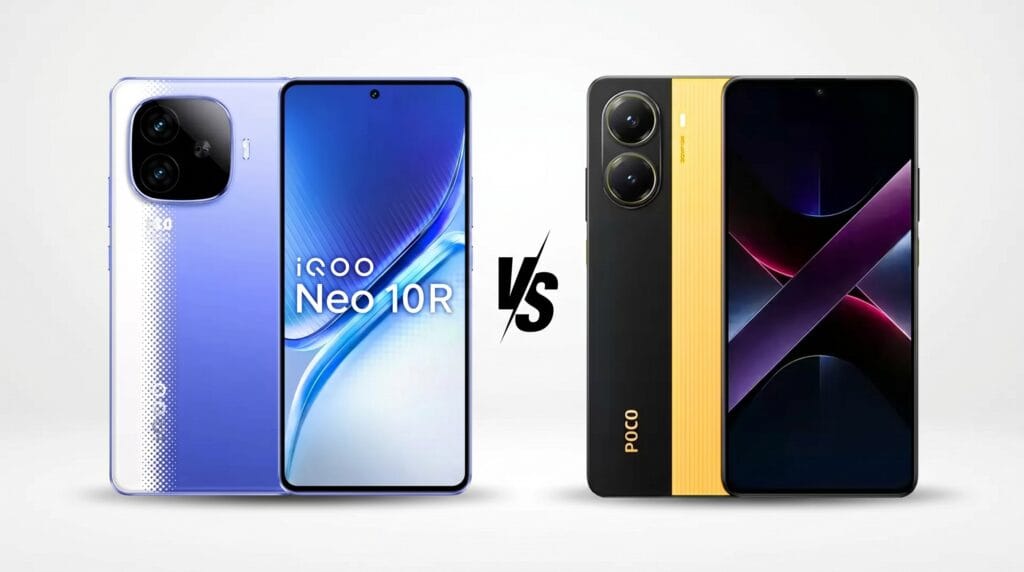
For current best-value picks across different budgets, see our best phone under 15000 guide and our iQOO Neo 10R vs POCO X7 Pro comparison — both identify the phones that deliver the most performance per rupee at their respective price points in 2026.
Frequently Asked Questions
Why are smartphone prices increasing in India in 2026?
Smartphone prices are increasing in India in 2026 because of five converging factors. The AI supercycle has redirected semiconductor manufacturing capacity toward AI chips, creating a global shortage of smartphone components. Memory chip prices rose up to 60% due to AI demand. The Indian rupee depreciated approximately 4.15% against the US dollar, raising the cost of all dollar-denominated component imports. GST on smartphones remains at 18% — unchanged since 2020. And every modern phone now requires more expensive hardware to support AI features and 5G connectivity.
What is the current GST on smartphones in India in 2026?
The GST on smartphones in India is 18% as of 2026 — confirmed unchanged at the 56th GST Council meeting in September 2025. This 18% rate applies to all smartphones regardless of brand or price segment. On a ₹15,000 phone, GST adds ₹2,700 — making the effective total ₹17,700. On a ₹25,000 phone, GST adds ₹4,500. Before April 2020, smartphones were taxed at 12% GST. The increase to 18% in 2020 added ₹500 to ₹3,000 to phone prices across all segments.
How much have smartphone prices increased in India in 2026?
According to IDC data for Q1 2026, average smartphone selling prices in India increased 10.4% year over year to a record average of approximately $302 — crossing ₹25,000 for the first time. Brands including Vivo, OPPO, Xiaomi, and Realme raised prices on specific models by ₹1,000 to ₹2,000 between late 2025 and early 2026. The sub-₹10,000 segment effectively collapsed with shipments falling 59%, as phones at that price point became inadequate for current software demands.
Will smartphone prices come down in India in 2026?
Smartphone prices are unlikely to come down significantly in India in the near term. The AI-driven memory chip shortage is a multi-year structural issue — semiconductor manufacturers continue to prioritise AI chip production over consumer electronics components. The rupee’s structural weakness against the dollar is unlikely to reverse meaningfully. GST on smartphones has not been reduced despite proposals. Short-term price relief comes primarily during festive season sales in October where discounts of 15 to 25% are available — but the base prices are expected to remain elevated or continue rising gradually through 2026.
Why is the budget smartphone segment disappearing in India?
The sub-₹10,000 smartphone segment in India fell 59% in Q1 2026 because component cost inflation has made it economically impossible to build a capable phone at that price. The chipsets available at the cost structures required for sub-₹10,000 phones are now too outdated to run Android 15, current AI features, or popular gaming titles adequately. Buyers who previously bought ₹8,000 phones are being pushed toward the ₹12,000 to ₹15,000 range where component quality allows a usable modern experience.
Does manufacturing phones in India reduce the price for buyers?
Domestic assembly under Make in India reduces prices by eliminating the 20% Basic Customs Duty on fully imported phones — a genuine saving that benefits Indian buyers of brands like Samsung, Xiaomi, and Realme. However, key components including chipsets, OLED displays, camera sensors, and batteries are still imported and carry their own duty structure. India does not yet manufacture chipsets domestically — all processors come from Taiwan, South Korea, and China. Until domestic semiconductor manufacturing matures, Indian-assembled phones remain dependent on imported components whose costs are driven by global factors outside India’s control.
Which is the best time to buy a smartphone in India to save money?
The best time to buy a smartphone in India is October during Amazon Great Indian Festival and Flipkart Big Billion Days — when discounts of 15 to 25% are available alongside 10% bank card offers. April to June also sees meaningful discounts during Amazon and Flipkart summer sales. Buying immediately after a new generation launches — when previous-generation phones receive their largest price drops — is the second-best strategy for value. A 2024 flagship phone bought in mid-2026 frequently offers better performance per rupee than a 2026 mid-range phone at the same price.
Data in this article is sourced from IDC India Q1 2026 smartphone market report, CyberMedia Research industry analysis, GST Council meeting records, and verified market data as of May 2026. All figures cited are from published industry research and official government sources.

Chandu Patel is a tech writer at OneRadar covering smartphones, gadgets, and consumer electronics in India. He writes honest buying guides, reviews, and price comparisons to help Indian buyers make smarter choices without overspending.