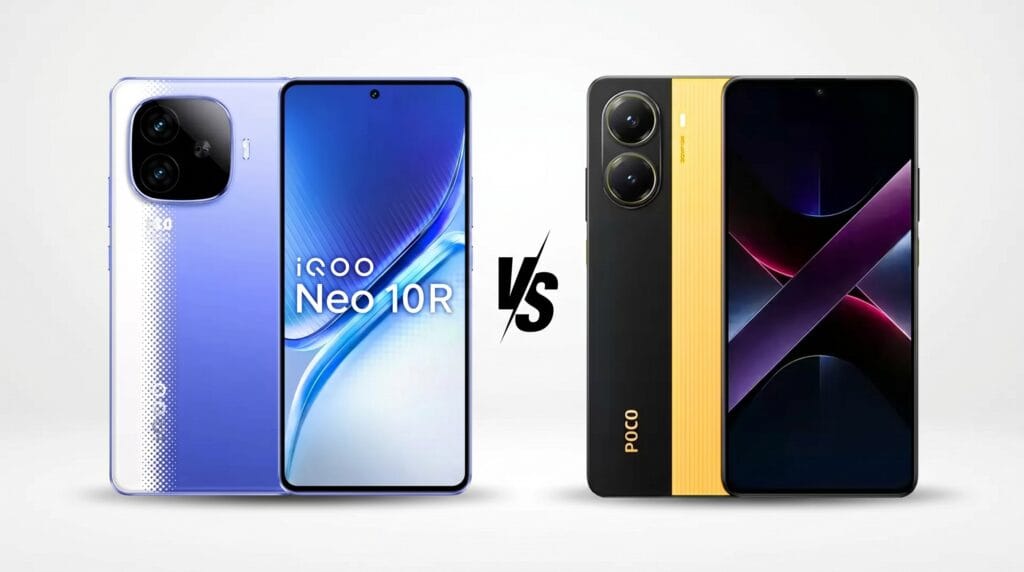
iQOO Neo 10R vs POCO X7 Pro — Which One Should You Buy in 2026?
₹6,000. That is the exact price difference between the iQOO Neo 10R at ₹29,999 and the POCO X7 Pro at ₹23,999. The question every Indian buyer is asking right now is whether that ₹6,000 gap is justified — or whether the POCO X7 Pro is simply the smarter buy.
The answer is not straightforward — and that is exactly why this comparison exists. Both phones are genuinely excellent at their prices. Both hit 90 FPS in BGMI. Both have 6,500mAh+ batteries. Both have 50MP Sony cameras. But they are built differently, tuned differently, and serve different types of buyers. One is the clear winner for competitive BGMI players. The other is the clear winner for buyers who want the most value per rupee. Understanding which you are determines everything.
This is the most honest iQOO Neo 10R vs POCO X7 Pro comparison for Indian buyers — covering every spec that actually matters with real benchmark data and genuine buyer feedback.
Quick Answer — Which One Should You Buy
If you do not want to read the full comparison, here is the short answer:
Buy the iQOO Neo 10R if: You play BGMI or COD Mobile competitively and need 120 FPS, you want a bigger display, you want better selfie camera quality, and service reliability from a Vivo brand centre matters to you.
Buy the POCO X7 Pro if: You want the best value for money under ₹25,000, you need NFC for Google Pay, you want IP68 + IP69 dual water resistance, faster 90W charging, and faster storage with UFS 4.0.
iQOO Neo 10R vs POCO X7 Pro — Full Specs Comparison
| Specification | iQOO Neo 10R | POCO X7 Pro |
|---|---|---|
| Price | ₹26,999 / ₹28,999 / ₹30,999 | ₹25,999 / ₹27,999 |
| Chipset | Snapdragon 8s Gen 3 | Dimensity 8400 Ultra |
| Display | 6.78-inch AMOLED 144Hz | 6.67-inch AMOLED 120Hz |
| Resolution | 1.5K (2800 × 1260) | 1.5K (2712 × 1220) |
| RAM | 8GB / 12GB LPDDR5X | 8GB / 12GB LPDDR5X |
| Storage | 128GB / 256GB UFS 3.1 | 256GB UFS 4.0 (all variants) |
| Rear Camera | 50MP f/1.8 + 8MP ultrawide | 50MP f/1.5 + 8MP ultrawide |
| Front Camera | 32MP | 20MP |
| Battery | 6,400mAh | 6,550mAh Silicon-Carbon |
| Charging | 80W | 90W |
| Water Resistance | IP64 | IP68 + IP69 |
| NFC | No | Yes |
| IR Blaster | Yes | No |
| 3.5mm Jack | No | No |
| AnTuTu Score | ~1.3 million | ~1.5 million |
| BGMI Max FPS | 120 FPS | ~70 FPS |
| OS | Funtouch OS 15 (Android 15) | HyperOS 2.0 (Android 15) |
| Software Updates | 3 years OS + 4 years security | 3 years OS + 4 years security |
Performance — The Most Surprising Result in This Comparison
This is where the comparison gets genuinely interesting — and where most buyers get confused.
On paper, the POCO X7 Pro looks faster. Its Dimensity 8400 Ultra scores approximately 1.5 million on AnTuTu 10 versus the iQOO Neo 10R’s 1.3 million. In GeekBench 6 multi-core testing, the POCO X7 Pro scores approximately 6,250 versus the Neo 10R’s 4,678. By raw benchmark numbers, the POCO X7 Pro wins.
But here is the twist that changes everything for gamers: BGMI performance tells the opposite story.
The iQOO Neo 10R supports 120 FPS in BGMI — confirmed after a game update in March 2025. It is one of very few phones in India under ₹30,000 that unlocks the 120 FPS tier in BGMI. The POCO X7 Pro, despite its higher AnTuTu score, peaks at approximately 70 FPS in BGMI due to how the Dimensity 8400 Ultra’s GPU handles the game engine’s rendering pipeline.
This gap is enormous for competitive players. 120 FPS in BGMI means you see and respond to opponents 70% faster than someone playing at 70 FPS. In a close-range gunfight, that difference is the difference between winning and dying.
For everything outside gaming — app loading, multitasking, Chrome, YouTube, social media — both phones are virtually indistinguishable in daily use. The Dimensity 8400 Ultra’s higher multi-core score is meaningless in real life because no daily app pushes either of these chips to their limit. Both feel equally fast, smooth, and lag-free in everyday use.
The thermal picture: The iQOO Neo 10R has a 4,000mm² vapour chamber. The POCO X7 Pro has a 5,000mm² LiquidCool 4.0 loop pump vapour chamber — 25% larger. Over extended 1-hour gaming sessions, the POCO X7 Pro stays marginally cooler. But the Neo 10R’s superior GPU performance in BGMI means it maintains 120 FPS without throttling before the thermal advantage of the X7 Pro’s larger chamber becomes relevant.
Storage speed note: The POCO X7 Pro’s UFS 4.0 storage is twice as fast as the iQOO Neo 10R’s UFS 3.1. Game install times, level loading in BGMI, and large file transfers are noticeably faster on the X7 Pro. This is a real-world advantage that benchmarks capture but daily use understates — BGMI’s large map loads complete faster on the POCO X7 Pro.
iQOO Neo 10R — Performance Verdict
OneRadar Gaming Rating: 9.2/10
The Snapdragon 8s Gen 3 with Adreno 735 GPU is the only reason the Neo 10R supports 120 FPS in BGMI while the X7 Pro cannot. For competitive players, this is the most important single specification in this entire comparison. No other phone under ₹30,000 in India gives you 120 FPS BGMI alongside a 144Hz display and 300Hz touch sampling in one package. The gaming experience on the iQOO Neo 10R is genuinely the best under ₹30,000 right now.
iQOO Neo 10R Pros and Cons
| Pros | Cons |
|---|---|
| 120 FPS BGMI — best gaming phone under ₹30,000 | No NFC — no Google Pay tap payments |
| 144Hz AMOLED with 300Hz touch sampling | UFS 3.1 storage — slower than X7 Pro |
| 32MP front camera — best selfie in this comparison | IP64 only — not splash-safe for rain |
| IR Blaster — control TV, AC, set-top box | 80W charging slower than X7 Pro’s 90W |
| iQOO Game Space optimisation suite | Higher price — ₹6,000 more than X7 Pro |
| Vivo brand service centres in India |
Best For: Competitive BGMI players who need 120 FPS, buyers who take a lot of selfies, and anyone who wants the best pure gaming performance under ₹30,000. Also great for buyers in cities with strong iQOO / Vivo service presence.
POCO X7 Pro — Performance Verdict
OneRadar Gaming Rating: 8.8/10
The Dimensity 8400 Ultra is a powerhouse in benchmarks and feels absolutely fast in daily use. The 70 FPS BGMI ceiling is the only meaningful gaming limitation — and for players who are comfortable at 60 to 70 FPS rather than needing 120 FPS, the X7 Pro’s gaming experience is completely satisfying. The UFS 4.0 storage is the fastest available at this price — BGMI loads faster, file transfers happen in seconds, and overall snappiness in storage-intensive tasks is ahead of the Neo 10R.
POCO X7 Pro Pros and Cons
| Pros | Cons |
|---|---|
| Best value under ₹25,000 — saves ₹6,000 vs Neo 10R | BGMI capped at ~70 FPS — no 120 FPS support |
| IP68 + IP69 — best water resistance in this comparison | No IR Blaster |
| NFC for Google Pay contactless payments | HyperOS has bloatware — heavier than Funtouch |
| UFS 4.0 — fastest storage in this comparison | 120Hz only — not 144Hz like Neo 10R |
| 6,550mAh Silicon-Carbon — slightly bigger battery | 20MP selfie camera behind Neo 10R’s 32MP |
| 90W charging — fastest in this comparison | |
| 197g — lighter than Neo 10R |
Best For: Budget-conscious buyers who want the most performance per rupee, buyers who need NFC for Google Pay and tap-to-pay, buyers who want the best water resistance, and casual gamers comfortable at 60-70 FPS who do not need 120 FPS BGMI.
Display — 144Hz vs 120Hz and What Actually Matters
Both phones have 1.5K AMOLED displays — genuinely excellent screens that are among the best available under ₹30,000.
The iQOO Neo 10R’s 6.78-inch 144Hz display is slightly larger and refreshes 20% more times per second than the POCO X7 Pro. The 144Hz combined with 300Hz touch sampling makes BGMI’s fast swipe-to-aim and hip-fire taps register in 3.3ms — among the fastest input response at this price. The 4,500 nits peak brightness is excellent in harsh Indian summer sunlight — fully readable outdoors.
The POCO X7 Pro’s 6.67-inch 120Hz display with 240Hz touch sampling is not behind in practice for most users. 120Hz scrolling looks equally smooth in social media, Chrome, and video apps. The touch response at 240Hz registers in 4.2ms — a 0.9ms difference from the Neo 10R that only the most precise competitive players notice. The POCO X7 Pro display peaks at 3,200 nits — slightly lower than the Neo 10R but still excellent outdoors.
For content consumption — YouTube, OTT streaming, photos — both displays are stunning. For competitive gaming, the Neo 10R’s 144Hz + 300Hz combination provides a measurable edge.
Camera — iQOO Neo 10R Wins Clearly
Both phones have a 50MP Sony IMX882 rear sensor — the exact same sensor. The difference is in aperture and tuning. The POCO X7 Pro’s wider f/1.5 aperture lets in more light than the iQOO Neo 10R’s f/1.8 — theoretically better in low light. In practice, Vivo’s image processing pipeline on the Neo 10R produces more natural, detailed photos with better dynamic range than POCO’s image processing on the X7 Pro.
The biggest camera difference is in selfies. The iQOO Neo 10R has a 32MP front camera that produces noticeably sharper, more detailed, and better-skin-toned selfies than the POCO X7 Pro’s 20MP front camera. For Indian buyers who use the front camera heavily for Instagram, reels, and video calls — this gap is visible and real. The Neo 10R selfies look distinctly better at the same shooting conditions.
Both phones shoot 4K at 60 FPS from the rear camera. The iQOO Neo 10R does not have the POCO X7 Pro’s Director Mode for multi-angle video — a feature content creators may find useful.
Camera winner: iQOO Neo 10R — same rear sensor but better image processing and a significantly better 32MP front camera.
Battery and Charging
The POCO X7 Pro’s 6,550mAh Silicon-Carbon battery edges ahead of the iQOO Neo 10R’s 6,400mAh cell — the 150mAh gap translates to approximately 15 to 20 minutes of additional BGMI gameplay. In daily use, both phones easily last a full day and most users get a day and a half before needing a charge.
The Silicon-Carbon anode technology in the POCO X7 Pro is a meaningful long-term advantage — Silicon-Carbon batteries degrade more slowly than standard lithium-ion cells, meaning the X7 Pro retains better battery capacity after 2 years of daily charging cycles compared to the Neo 10R.
Charging speed: The POCO X7 Pro’s 90W charging fills the 6,550mAh battery in approximately 38 to 40 minutes — the fastest in this comparison. The iQOO Neo 10R’s 80W charging fills the 6,400mAh battery in approximately 50 to 55 minutes. The 10 to 15-minute faster full charge on the X7 Pro is a genuine daily convenience advantage.
Bypass charging on the iQOO Neo 10R is worth mentioning — when gaming while plugged in, power routes directly to the phone’s components rather than through the battery, reducing heat and preventing battery degradation during long charging-while-gaming sessions.
Battery winner: POCO X7 Pro — larger Silicon-Carbon battery and faster 90W charging.
Software — Funtouch OS vs HyperOS
The iQOO Neo 10R runs Funtouch OS 15 based on Android 15 — Vivo’s software layer that is clean, feature-rich, and specifically optimised for gaming through iQOO Game Space. The interface is fast, animations are smooth, and the gaming tools are the best-in-class at this price. The main criticism: Funtouch OS is not as customisable as HyperOS and has a slightly heavier visual style that some users find less clean.
The POCO X7 Pro runs HyperOS 2.0 based on Android 15 — Xiaomi’s latest software that brings better multitasking, more themes, better always-on display customisation, and excellent second-space and clone-app features. The downside: HyperOS comes with noticeable bloatware — pre-installed apps that cannot be uninstalled without developer options. Several Indian buyers report spending 20 to 30 minutes removing or disabling unwanted apps after first setup.
Auto call recording is available on both phones through their default dialer apps — important for Indian buyers who rely on this for business calls and client conversations.
Both phones receive 3 years of Android OS updates and 4 years of security patches — equal software longevity.
NFC — The Feature That Decides for Many Buyers
The POCO X7 Pro has NFC. The iQOO Neo 10R does not. This single feature difference is a deal-breaker for a growing segment of Indian buyers in 2026.
NFC on a smartphone enables Google Pay tap-to-pay — touching your phone to a payment terminal at a store, metro station, or restaurant to complete a transaction without opening an app or scanning a QR code. With NFC payment acceptance growing across Indian metro cities at petrol stations, pharmacies, supermarkets, and QR-less metro gates — the absence of NFC on the Neo 10R is a practical daily limitation that ₹6,000 of extra price cannot compensate for.
If Google Pay tap payments are a feature you currently use or plan to use — buy the POCO X7 Pro. There is no workaround for missing NFC.
Water Resistance — POCO X7 Pro is Far Ahead
The iQOO Neo 10R is rated IP64 — protection against dust and water splashes from any direction. It handles light rain and accidental splashes. It is not designed for water submersion and should not be used near swimming pools or in heavy rain.
The POCO X7 Pro is rated IP68 + IP69 — full dust protection and submersion in up to 1.5 metres of fresh water for 30 minutes, plus protection against high-pressure water jets. You can use it in heavy rain, near water, drop it in a bucket, and it survives without damage.
For a phone at ₹23,999, IP68 + IP69 dual certification is genuinely remarkable value. The iQOO Neo 10R costs ₹6,000 more and offers significantly weaker water resistance.
Who Should Buy Which Phone
Buy the iQOO Neo 10R if you:
Play BGMI or COD Mobile competitively and need 120 FPS — this is the only reason that matters and it is decisive for serious gamers. Take a lot of selfies — the 32MP front camera is meaningfully better. Use an IR Blaster daily to control your TV, AC, or set-top box. Live near an iQOO or Vivo service centre and value in-person service access. Are comparing to other phones in this range — see our best gaming phones under 30000 guide for how the Neo 10R stacks up against the full field.
Buy the POCO X7 Pro if you:
Want the best value under ₹25,000 and ₹6,000 is a meaningful saving. Use or plan to use Google Pay tap payments via NFC. Want the best water resistance — IP68 + IP69 handles heavy rain, pools, and drops in water. Want the fastest charging — 90W fills the phone in under 40 minutes. Play BGMI casually at 60 to 70 FPS and do not need 120 FPS competitive performance. Want the fastest storage — UFS 4.0 on every variant.
iQOO Neo 10R vs POCO X7 Pro — The OneRadar Verdict
For competitive gamers: The iQOO Neo 10R wins decisively. 120 FPS BGMI is the single most important gaming metric under ₹30,000 right now and only the Snapdragon 8s Gen 3 delivers it. If BGMI is your primary use case — stop reading, buy the Neo 10R.
For everyone else: The POCO X7 Pro wins on value. NFC, IP68+IP69, UFS 4.0, 90W charging, Silicon-Carbon battery, and a ₹6,000 lower price point make it the better all-round daily driver for buyers who are not specifically optimising for 120 FPS gaming.
The ₹6,000 price gap is exactly the width of the decision — if you game competitively, pay it. If you do not, save it.
For reviews of both phones individually, read our iQOO Z11x 5G review to understand iQOO’s full India lineup positioning, and our OnePlus Nord 6 review for the best ₹30,000 alternative if neither phone convinces you.
If your budget is lower, our best phone under 15000 guide covers the best options at half this price.
Frequently Asked Questions
Which is better for BGMI — iQOO Neo 10R or POCO X7 Pro?
The iQOO Neo 10R is decisively better for BGMI. It supports 120 FPS gameplay in BGMI after the March 2025 game update, making it one of the only phones under ₹30,000 in India to unlock the 120 FPS tier. The POCO X7 Pro peaks at approximately 70 FPS in BGMI despite having a higher AnTuTu benchmark score. This is because the Snapdragon 8s Gen 3’s Adreno 735 GPU handles BGMI’s rendering engine better than the Dimensity 8400 Ultra’s Mali-G720 MC7. For serious competitive BGMI players, the iQOO Neo 10R is the clear choice.
Is POCO X7 Pro worth buying over iQOO Neo 10R?
Yes — for most everyday buyers who do not play competitive BGMI at 120 FPS, the POCO X7 Pro is absolutely worth buying. It saves ₹6,000, has NFC for Google Pay, IP68 + IP69 water resistance, faster 90W charging, a larger Silicon-Carbon battery, and faster UFS 4.0 storage. The only areas where the Neo 10R beats it are 120 FPS BGMI support, 144Hz display, and the 32MP front camera.
Which has better camera — iQOO Neo 10R or POCO X7 Pro?
Both phones use the same 50MP Sony IMX882 rear sensor with OIS. The POCO X7 Pro has a wider f/1.5 aperture versus the Neo 10R’s f/1.8 — theoretically better in low light. However, the iQOO Neo 10R’s image processing produces more natural and detailed photos in real-world conditions. The biggest camera difference is in selfies — the Neo 10R has a 32MP front camera against the X7 Pro’s 20MP, producing noticeably sharper and better-toned selfies. Overall camera winner is the iQOO Neo 10R, primarily because of the front camera.
Does iQOO Neo 10R have NFC?
No — the iQOO Neo 10R does not have NFC. This means Google Pay tap-to-pay payments at NFC terminals are not possible on the Neo 10R. The POCO X7 Pro does have NFC and supports Google Pay contactless payments. If NFC is important for your daily payment habits, choose the POCO X7 Pro.
Which phone has better battery life — iQOO Neo 10R or POCO X7 Pro?
The POCO X7 Pro has slightly better battery life with a 6,550mAh Silicon-Carbon battery versus the Neo 10R’s 6,400mAh standard lithium-ion cell. The Silicon-Carbon technology also means the X7 Pro’s battery degrades more slowly over time — retaining better capacity after 2 years of daily charging. The X7 Pro also charges faster at 90W (38 to 40 minutes full charge) compared to the Neo 10R’s 80W (50 to 55 minutes).
What is the price difference between iQOO Neo 10R and POCO X7 Pro?
The POCO X7 Pro starts at ₹25,999 for 8GB + 256GB and ₹27,999 for 12GB + 256GB. The iQOO Neo 10R starts at ₹26,999 for 8GB + 128GB, ₹28,999 for 8GB + 256GB, and ₹30,999 for 12GB + 256GB. The equivalent comparison — 8GB + 256GB — is ₹25,999 for POCO X7 Pro versus ₹28,999 for iQOO Neo 10R, a difference of ₹3,000. The entry variants differ by ₹1,000. On the 12GB variants, the difference is ₹3,000 in favour of POCO.
Which phone is better for daily use — iQOO Neo 10R or POCO X7 Pro?
For daily use outside gaming, the POCO X7 Pro is the better all-round choice. NFC for payments, better water resistance (IP68+IP69 vs IP64), lighter weight (197g vs 217g), and faster charging (90W vs 80W) make it a more practical daily driver. The iQOO Neo 10R’s IR blaster is useful for those who want to control home appliances from their phone — the X7 Pro does not have this. Both phones have excellent displays, smooth software, and comfortable daily performance on the same chipset generation.
Prices in this comparison are based on current Amazon India and Flipkart listings as of April 2026. Prices change during sale events — always check the retailer for the current best price before purchasing. Benchmark scores referenced are from Smartprix and verified sources. OneRadar updates this comparison as pricing or software updates change the verdict.

Chandu Patel is a tech writer at OneRadar covering smartphones, gadgets, and consumer electronics in India. He writes honest buying guides, reviews, and price comparisons to help Indian buyers make smarter choices without overspending.