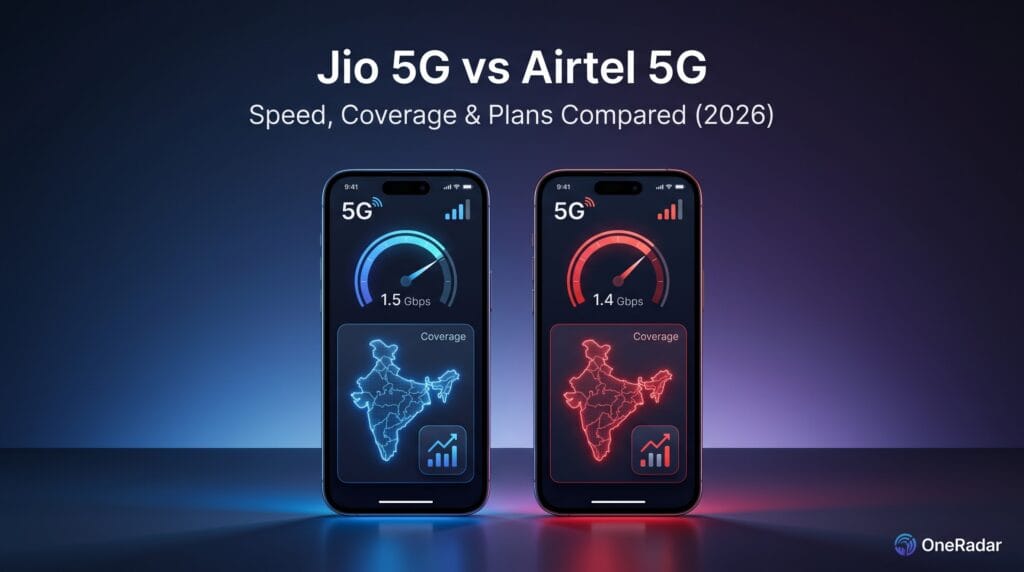
Jio 5G vs Airtel 5G India 2026 — Speed, Coverage and Plans Honestly Compared
The Jio 5G vs Airtel 5G India debate is the most important telecom question for Indian smartphone users in 2026 — and the honest answer is more nuanced than most people expect. Both networks have expanded dramatically across India, both deliver genuinely fast speeds, and both offer competitive plans. But they are built on fundamentally different technology, serve different use cases better, and perform very differently depending on whether you live in a metro city, a Tier 2 town, or a rural area.
This guide covers the complete Jio 5G vs Airtel 5G India comparison for 2026 — real speed data, coverage maps, network architecture explained simply, plan comparisons, Vi 5G’s current status, and an honest verdict on which network to choose based on your actual situation.
Jio 5G vs Airtel 5G India — Quick Verdict Before the Full Comparison
For buyers who want the answer immediately before reading the full analysis:
Choose Jio 5G if: You live in a Tier 2 or Tier 3 city, want the widest 5G coverage across India, travel frequently between cities, or want the most data for the least money.
Choose Airtel 5G if: You live in a major metro, need consistent speeds inside buildings and basements, stream high-quality video and make frequent video calls, or want OTT bundling with Amazon Prime Video.
For Vi 5G: Currently available only in Mumbai, Delhi, Chandigarh, and Patna in limited areas. Not a realistic choice for most Indian users in 2026.
The Fundamental Difference — SA vs NSA 5G
Before comparing speeds and coverage, understanding the technology difference between Jio and Airtel’s 5G networks explains everything else in this comparison.
Jio uses Standalone (SA) 5G — JioTrue5G. A standalone 5G network operates completely independently from the older 4G infrastructure. Every component — the radio towers, the core network, the control functions — is built on 5G technology from the ground up. Jio invested heavily in building this independent 5G core alongside its 4G network. The result is a 5G network that achieves genuinely lower latency, handles more simultaneous users, and delivers more consistent performance than a network that piggybacks on 4G infrastructure.
Airtel uses Non-Standalone (NSA) 5G — Airtel 5G Plus. A non-standalone 5G network uses the existing 4G LTE infrastructure as its anchor for signalling and control functions, while adding 5G for the data layer. Airtel’s approach allowed much faster initial rollout because it reused its already-extensive 4G tower network. The trade-off is that NSA 5G cannot achieve the full latency and capacity benefits of standalone 5G because some functions still run through the 4G core.
What this means in practice: Jio’s SA 5G delivers lower latency for gaming and real-time applications. Airtel’s NSA 5G often delivers better building penetration and more consistent speeds in specific urban environments because it can fall back to its mature 4G layer seamlessly. For most Indian users — streaming, browsing, social media — the SA vs NSA difference is invisible in daily use. For competitive gaming and real-time applications, Jio’s lower latency is measurable.
Jio 5G vs Airtel 5G Speed — What the Data Actually Shows
Speed comparisons between Indian telecom operators get complicated because measurements vary by location, time of day, and testing method. Here is the honest picture from independent measurement data.
Jio 5G average download speed: According to OpenSignal’s India mobile network experience data, Jio leads in 5G download speed availability — meaning the percentage of time Jio users actually experience 5G speeds. Jio’s average 5G download speed measured in real-world conditions across Indian cities ranges from 150 Mbps to 300 Mbps in mid-band n78 coverage areas. In peak conditions with strong n78 signal, speeds exceed 500 Mbps. Jio’s 5G availability — the percentage of time users are connected to 5G rather than 4G — is the highest of any Indian operator at approximately 70%.
Airtel 5G average download speed: Airtel’s 5G performance is the most consistent of the two major operators in urban areas. OpenSignal’s India mobile network report ranks Airtel ahead of Jio in peak 5G download speeds in several major metros — delivering 200 Mbps to 800 Mbps in well-covered urban zones. However, Airtel’s 5G availability percentage is lower than Jio’s — meaning Airtel users spend less time on 5G and more time falling back to 4G LTE compared to Jio users.
The honest comparison: Jio delivers faster speeds more consistently across a wider geographic area. Airtel delivers higher peak speeds in specific well-covered urban zones. For a user in Hyderabad’s Hitec City — Airtel 5G might give you faster peak speeds at your desk. For a user travelling between Hyderabad, Warangal, and Nalgonda — Jio 5G maintains 5G connectivity significantly more of the time.
Upload speeds: Both operators are comparable on upload speeds — typically 15 Mbps to 50 Mbps in real-world conditions. Upload speed matters for video calls, cloud backups, and content creators — and neither operator has a significant advantage here.
Latency — Jio wins clearly: Jio’s SA 5G architecture delivers latency of 10ms to 20ms in good conditions. Airtel’s NSA 5G delivers latency of 20ms to 35ms. For competitive BGMI and COD Mobile gameplay where latency directly determines whether you register shots before your opponent — Jio’s lower latency is a genuine advantage. For Netflix streaming, latency is irrelevant.
Jio 5G vs Airtel 5G Coverage India 2026
Jio 5G coverage: Jio has deployed 5G across 700+ cities and towns in India as of 2026. This includes all state capitals, most district headquarters, and significant Tier 2 city coverage. Jio’s low-band n28 (700 MHz) spectrum gives it an additional coverage advantage — 700 MHz signals travel further from towers and penetrate buildings more effectively than mid-band frequencies. This is why Jio 5G often works in areas where Airtel 5G cannot maintain signal.
Airtel 5G coverage: Airtel has deployed 5G across 500+ cities with strong coverage in metros and major Tier 1 cities. Airtel’s NSA approach, while limiting in some technical aspects, allowed very fast urban rollout — in cities like Mumbai, Delhi, Bengaluru, and Hyderabad, Airtel’s 5G coverage is dense and consistent in commercial and residential areas. Airtel’s multiple-band approach using n1, n3, n8, and n78 means good coverage across different building types and environments.
For Tier 2 and Tier 3 cities — Jio wins clearly. If you live in or regularly visit cities like Warangal, Mysore, Coimbatore, Vijayawada, Surat, Nagpur, Indore, or any similar Tier 2 city — Jio 5G is almost certainly available. Airtel 5G may be absent or limited in these areas.
For metros — roughly equal. In Mumbai, Delhi, Bengaluru, Hyderabad, Chennai, Kolkata, Pune, and Ahmedabad — both operators provide good 5G coverage in most commercial and residential areas. Building penetration varies by specific location and cannot be predicted without testing at your exact address.
For rural areas — Jio is the only realistic 5G option. Airtel’s 5G rollout is concentrated in urban India. Jio’s n28 low-band spectrum enables 5G in rural areas where no other operator currently offers it.
Jio 5G vs Airtel 5G Plans India 2026 — Value Comparison
Plans change frequently. These figures are indicative of the current pricing structure rather than exact current rates — always check the operator’s app for the latest prices.
Jio 5G Plans:
Jio includes 5G access in its standard prepaid plans above ₹299 per month at no extra charge. The ₹299 plan provides 28 days validity with 2GB daily data and unlimited calls. The ₹666 plan provides 84 days validity with 2GB daily data — the most popular long-validity plan. The ₹999 plan provides 84 days with 3GB daily data and JioCinema Premium bundled. The ₹3,599 annual plan covers 365 days with 2.5GB daily data and JioCinema bundled throughout the year.
Jio’s bundled entertainment is JioCinema Premium — which includes HBO content including Game of Thrones, House of the Dragon, and Warner Bros. originals alongside Indian content. This is a significant value addition for entertainment-focused users.
Airtel 5G Plans:
Airtel includes 5G access in its plans above ₹299 per month. The ₹299 plan provides 28 days with 2GB daily data. The ₹479 plan provides 56 days with 2.5GB daily data. The ₹799 plan provides 84 days with 2GB daily data plus Amazon Prime Video and Apollo 24/7 Circle membership. The ₹3,599 annual plan covers 365 days with 2.5GB daily data and bundled benefits.
Airtel’s bundled Amazon Prime Video is the standout value proposition — Amazon Prime alone costs approximately ₹1,499 per year, so plans that include it effectively cost ₹1,499 less than the listed price for buyers who use Amazon Prime for shopping and streaming.
Plan comparison verdict: Jio offers more data for slightly less money. Airtel offers better OTT bundling value — Amazon Prime Video significantly outweighs JioCinema Premium for buyers who use Amazon for shopping or watch Amazon’s original content. For pure data volume per rupee — Jio wins. For content and lifestyle bundle value — Airtel wins.
Jio 5G vs Airtel 5G for Specific Use Cases
For BGMI and online gaming: Choose Jio. The lower latency from Jio’s SA 5G architecture (10ms to 20ms vs Airtel’s 20ms to 35ms) directly reduces ping in BGMI. Lower ping means opponents’ movements register faster, and your shots hit before the opponent’s. Jio’s wider coverage also means you maintain 5G rather than dropping to 4G mid-match in areas where Airtel’s 5G signal is absent. For the best gaming phones to pair with Jio 5G, see our best gaming phones under 30000 guide.
For video streaming (Netflix, Prime Video, Hotstar): Both networks are more than fast enough for 4K streaming. The practical difference is zero for Netflix or YouTube. If you specifically watch Amazon Prime Video — the Airtel bundled plan gives you Prime membership included which changes the value calculation significantly.
For video calls (WhatsApp, Google Meet, Zoom): Airtel delivers more consistent video call quality in dense urban environments — its multi-band NSA approach maintains stable speeds in the specific environments where video calls happen most. Jio is comparable but slightly more variable in areas where its 5G signal bounces between bands.
For travel across India: Choose Jio decisively. The combination of 700+ city 5G coverage and low-band n28 spectrum means you are on 5G more hours of the day across more of India’s geography than any other network. Airtel drops to 4G significantly more often outside major metros.
For in-building use (offices, malls, apartments): This is the one scenario where Airtel’s advantage is most consistent. Airtel’s NSA network uses lower frequency bands — n1 at 2100 MHz and n3 at 1800 MHz alongside n78 — which penetrate concrete walls better than pure n78 mid-band. In a basement office or a high-rise apartment above the 15th floor, Airtel often maintains better 5G signal than Jio.
Vi 5G — Honest Status in 2026
Vi (Vodafone Idea) launched 5G commercially in four cities — Mumbai, Delhi, Chandigarh, and Patna. Coverage within these cities is limited to specific zones rather than comprehensive rollout.
Vi has added 23 new cities to its commercial 5G deployment list in early 2026 and average download speeds on Vi 5G have improved by approximately 3 Mbps according to available data. These are positive developments — but Vi’s 5G footprint remains dramatically smaller than Jio’s 700+ cities and Airtel’s 500+ cities.
Vi’s financial situation has improved following the government’s equity conversion of Vi’s dues — but the operator is still significantly behind Jio and Airtel in 5G capital expenditure and tower deployments. Vi’s 5G network in 2026 is appropriate only for buyers who are specifically in one of its covered cities and are already satisfied Vi customers with no compelling reason to switch.
For most Indian buyers evaluating a new SIM or considering switching networks in 2026 — the choice is realistically between Jio and Airtel. Vi 5G is not yet a mainstream recommendation.
BSNL — The Fourth Option Worth Knowing About
BSNL’s 5G plans have been delayed repeatedly. In 2026, BSNL operates an extensively improved 4G network with 97,068 deployed 4G sites. BSNL’s 4G network is now significantly more capable than it was a year ago — particularly relevant for rural and semi-urban users where Jio and Airtel coverage may be limited.
BSNL plans remain the most affordable in India — typically ₹50 to ₹100 cheaper per 28-day cycle than equivalent Jio or Airtel plans. For budget-conscious buyers in areas with good BSNL 4G coverage — BSNL is a viable option. For 5G specifically — BSNL’s commercial 5G rollout timeline remains uncertain as of May 2026.
How to Switch From Jio to Airtel or Airtel to Jio — MNP Guide
If this comparison convinces you to switch networks — you can keep your existing mobile number using Mobile Number Portability (MNP).
Send an SMS to 1900 with the text PORT followed by a space and your 10-digit mobile number. Example: PORT 9876543210. You will receive a porting code within minutes. Take this code to a store of the network you want to switch to and request a new SIM with your existing number. The porting process takes 3 to 7 working days. During this period your existing SIM continues to work until the switch is complete.
For the new SIM — choose your phone’s n78 compatible model if you want 5G on either network. Read our how to check 5G phone India guide to verify your phone supports the right 5G bands before switching.
Jio 5G vs Airtel 5G India — Final Verdict
Jio 5G wins on: Coverage (700+ cities vs 500+), latency (10-20ms vs 20-35ms), 5G availability percentage (70% vs lower), rural and Tier 2 reach, and data volume per rupee in plans.
Airtel 5G wins on: Peak speeds in major metros, in-building penetration, OTT bundle value (Amazon Prime), and consistent quality in dense urban environments.
The honest recommendation: For most Indian users in 2026 — choose Jio 5G. The combination of wider coverage, lower latency, higher 5G availability percentage, and competitive pricing makes it the better choice for the majority of Indian smartphone users. The only scenario where Airtel clearly wins is when you are permanently based in a major metro, rarely travel to Tier 2 cities, and specifically want the Amazon Prime bundling.
Frequently Asked Questions
Which is better — Jio 5G vs Airtel 5G in India in 2026?
For most Indian users, Jio 5G is the better choice in 2026. Jio leads in 5G coverage with 700+ cities, 5G availability percentage at approximately 70%, lower latency of 10 to 20ms for gaming, and wider rural and Tier 2 city coverage. Airtel 5G is better for users permanently based in major metros who want consistent in-building speeds and Amazon Prime Video bundled in their plan. The fundamental technology difference — Jio’s Standalone 5G vs Airtel’s Non-Standalone 5G — gives Jio a structural latency advantage that benefits gaming and real-time applications.
What is the difference between Jio True 5G and Airtel 5G Plus?
Jio True 5G uses Standalone (SA) architecture — a completely independent 5G network with no dependence on 4G infrastructure. This delivers lower latency and higher capacity. Airtel 5G Plus uses Non-Standalone (NSA) architecture — the 5G data layer runs on Airtel’s existing 4G core network for signalling and control. NSA allowed faster initial rollout but creates higher latency than SA. For everyday streaming and browsing the difference is negligible. For competitive gaming and real-time applications, Jio’s SA 5G latency advantage is measurable.
Is Vi 5G available in India in 2026?
Vi 5G is commercially available in four cities — Mumbai, Delhi, Chandigarh, and Patna — with 23 additional cities added to its deployment list in early 2026. Vi’s 5G coverage is significantly smaller than Jio’s 700+ cities and Airtel’s 500+ cities. For most Indian users, Vi 5G is not yet a mainstream choice. Vi’s 4G network has improved substantially and remains a viable budget option for users in areas where Vi coverage is strong.
Which 5G network has better coverage in India — Jio or Airtel?
Jio has better 5G coverage in India in 2026 — 700+ cities compared to Airtel’s 500+ cities. Jio’s coverage advantage is most pronounced in Tier 2 cities, Tier 3 towns, and rural areas. Jio’s low-band n28 (700 MHz) spectrum travels further from towers and penetrates buildings better than mid-band frequencies, enabling 5G in areas where Airtel 5G cannot maintain signal. In major metro cities, both operators have comparable coverage in commercial and most residential areas.
Which network is better for BGMI in India — Jio or Airtel?
Jio is the better network for BGMI in India. Jio’s Standalone 5G architecture delivers latency of 10 to 20ms compared to Airtel’s 20 to 35ms. In BGMI, lower ping means opponents’ movements register faster and shots hit before the opponent’s in close-range fights. Jio’s higher 5G availability also means you stay on 5G rather than dropping to 4G mid-match. For competitive BGMI players, Jio 5G is the clear choice.
Which Airtel or Jio plan gives the best value in India in 2026?
For pure data volume per rupee, Jio plans offer marginally more data for comparable prices. For OTT bundle value, Airtel’s ₹799 plan which includes Amazon Prime Video and Apollo 24/7 Circle membership delivers exceptional value — Amazon Prime Video alone costs ₹1,499 per year, making the bundle effectively cheaper than its listed price for Prime users. For long-validity planning, Jio’s annual plans at ₹3,599 and Airtel’s equivalent plans are similarly priced with different OTT benefits. Choose based on whether you value JioCinema Premium (HBO content) or Amazon Prime Video more.
How do I switch from Jio to Airtel or Airtel to Jio without changing my number?
Use Mobile Number Portability (MNP). Send an SMS to 1900 with the text PORT followed by a space and your 10-digit mobile number. You will receive a porting code. Take this code to the new operator’s store and request a SIM with your existing number. The switch takes 3 to 7 working days. Your existing SIM works normally until the porting is complete. Before switching, confirm your phone supports the new operator’s 5G bands — read our how to check 5G phone India guide for the exact steps.
Network speed data in this article is sourced from OpenSignal’s India mobile network experience reports and verified industry sources as of May 2026. Network performance varies significantly by location, time of day, and local tower density. Always test network performance at your home and office specifically before switching operators. Plan prices and features change frequently — check the MyJio or Airtel Thanks app for current pricing.

Chandu Patel is a tech writer at OneRadar covering smartphones, gadgets, and consumer electronics in India. He writes honest buying guides, reviews, and price comparisons to help Indian buyers make smarter choices without overspending.