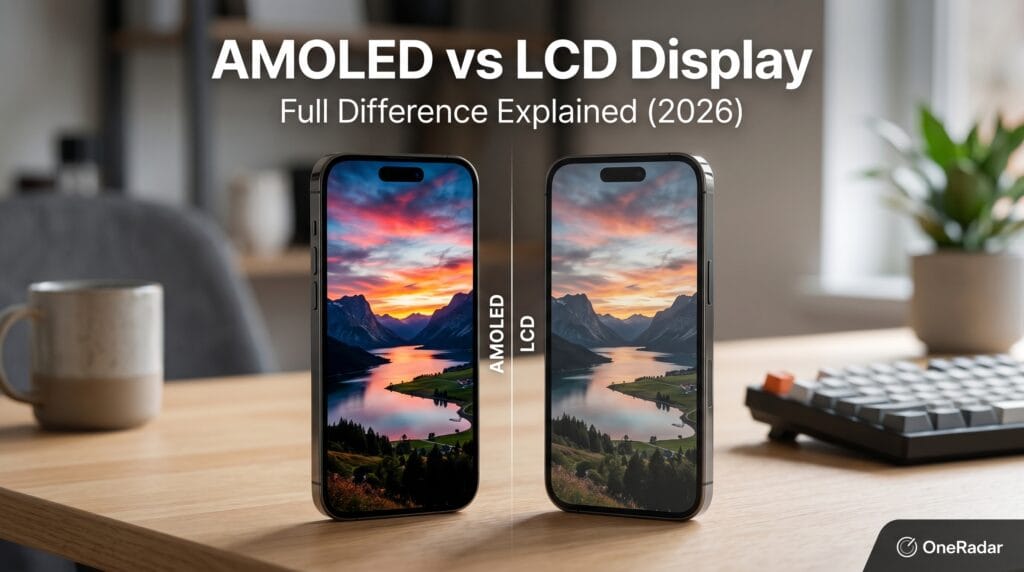
Every smartphone specification sheet mentions a display type — AMOLED, LCD, OLED, Super AMOLED, Dynamic AMOLED, LTPO AMOLED — and most Indian buyers skip past it entirely because the terminology feels technical. This is a mistake, because the AMOLED vs LCD display difference directly affects four things you experience every single day: how bright the screen looks in harsh Indian afternoon sunlight, how long the battery lasts, how the screen looks at night, and whether your eyes feel strained after long sessions.
This guide explains the AMOLED vs LCD display difference from the ground up — in plain language, without engineering jargon, specifically for Indian usage conditions. By the end you will know exactly which display type to look for based on how you actually use your phone.
How an LCD Display Works — The Flashlight Inside Your Phone
LCD stands for Liquid Crystal Display. To understand how it works, picture a torch shining through a coloured filter. That is essentially what an LCD screen does.
Inside every LCD panel, there is a backlight — usually a row of white LEDs running along the edge of the display. This backlight is always on whenever the screen is active. The light from the backlight passes through a layer of liquid crystals — molecules that can be twisted or untwisted by applying an electrical charge. When the crystals are twisted one way, they block the backlight. When twisted another way, they let it through. Behind each pixel, three tiny colour filters — red, green, and blue — mix the light passing through to create every colour you see on screen.
The critical implication of this design is that the backlight never fully switches off. Even when your screen displays a completely black image, the backlight behind it is still shining at full power. The liquid crystals are blocking most of that light — but never all of it. This is why true black on an LCD screen is actually a very dark grey when you look closely. The light is leaking through.
LCD types you will see on phone spec sheets:
IPS LCD (In-Plane Switching) is the most common LCD type in smartphones. It has good colour accuracy and wide viewing angles — you can see the screen clearly from the side without colours washing out. Most budget and mid-range phones below ₹10,000 use IPS LCD.
TFT LCD (Thin Film Transistor) is an older, cheaper LCD variant. Colours are less accurate, viewing angles are narrower, and response times are slower. You will find TFT LCD only on the cheapest smartphones below ₹7,000 in 2026.
How an OLED Display Works — Every Pixel Is Its Own Light
OLED stands for Organic Light-Emitting Diode. The technology works in a completely different way from LCD — and understanding this difference explains why premium phones almost universally use OLED.
In an OLED display, there is no separate backlight. Instead, every single pixel contains organic compounds that emit their own light when an electrical current passes through them. Each pixel is independently controlled — it can be made bright, dim, or switched off completely. When your screen displays a black area, those pixels are genuinely off. No light, no power, no leakage.
The difference in black levels between OLED and LCD is not subtle — it is absolute. An OLED screen displaying a black background is indistinguishable from a switched-off screen in a dark room. An LCD screen displaying the same black background glows visibly because the backlight cannot be fully blocked.
What AMOLED Means — And Why It Is Not the Same as OLED
AMOLED stands for Active Matrix Organic Light-Emitting Diode. It is a type of OLED — not a separate technology. The difference is in how the pixels are controlled.
A basic OLED display uses a Passive Matrix system — pixels are controlled row by row, which is slow and inefficient for large displays. AMOLED adds an Active Matrix layer — a grid of thin-film transistors (TFTs) that gives each pixel its own dedicated transistor for direct, individual control. This allows AMOLED screens to refresh faster, respond to touch faster, and scale to larger screen sizes without performance degradation.
Every AMOLED screen is an OLED screen. Not every OLED screen is an AMOLED screen. In smartphone usage, the distinction is largely irrelevant for the buyer — when a phone spec sheet says OLED or AMOLED, both mean self-emissive pixels with genuine black levels. The practical experience is the same.
Super AMOLED, Dynamic AMOLED, LTPO AMOLED — What Each Means
Samsung and other brands use these extended names in their marketing. Here is what each actually means for your daily use.
Super AMOLED is Samsung’s term for an AMOLED panel where the capacitive touch layer is integrated directly into the display rather than being a separate layer on top of it. This makes the display thinner and reduces the distance between the glass surface and the actual pixels — making text and images appear sharper and closer to the surface of the glass. It also reduces reflections in bright light. Super AMOLED is present on Samsung Galaxy A and M series phones. Samsung’s official Dynamic AMOLED technology page.
Dynamic AMOLED is Samsung’s marketing name for their flagship AMOLED panels with HDR10+ certification, wider colour gamut, and higher peak brightness. You will see Dynamic AMOLED on Samsung Galaxy S series phones. It is the same underlying technology as Super AMOLED but with a more premium panel calibration and higher brightness output.
LTPO AMOLED is the most important variant to understand. LTPO stands for Low Temperature Polycrystalline Oxide. An LTPO AMOLED display can vary its refresh rate dynamically — from as low as 1Hz when displaying a static image or an Always-On Display, up to 120Hz or 144Hz during gaming or fast scrolling. Standard AMOLED runs at a fixed refresh rate regardless of content. LTPO AMOLED saves significant battery by reducing the refresh rate when the display does not need to update frequently. The Always-On Display on premium phones that shows the time without waking the screen is possible because LTPO drops to 1Hz — consuming virtually no power.
You will find LTPO AMOLED on phones like the Vivo X300 FE, OnePlus Nord CE 6, Realme GT 7T, Samsung Galaxy S series, and Apple iPhone 17 series. Budget and mid-range phones use standard fixed-rate AMOLED.
AMOLED vs LCD Display — The 6 Differences That Matter for Indian Buyers
1. Black Levels and Contrast — AMOLED Wins
An AMOLED screen switches off pixels to display black. An LCD screen cannot switch off its backlight. This means AMOLED delivers essentially infinite contrast — the ratio between the brightest white and the darkest black is mathematically near-infinite because true black is truly zero light output.
In practice, this difference is most visible when watching movies and web series on OTT platforms like Netflix, Prime Video, and Hotstar. Dark scenes — night sequences, indoor scenes — look dramatically better on AMOLED. Shadows have depth and detail. On an LCD screen, those same scenes have a faint grey glow over the dark areas that reduces perceived depth.
For Indian buyers who watch a significant amount of Bollywood and South Indian films — where dramatic lighting with deep shadows is common — this difference is immediately noticeable after switching from LCD to AMOLED.
2. Brightness and Sunlight Visibility — LCD Has a Historical Advantage, AMOLED Is Catching Up
This is the most misunderstood part of the AMOLED vs LCD display comparison. The older answer was: LCD is better in direct sunlight. In 2026, this is no longer reliably true.
Modern AMOLED displays peak at 3,000 to 5,000 nits. The Vivo X300 Ultra reaches 5,000 nits. The Realme GT 7T reaches 6,000 nits. These brightness levels are far above what any LCD screen can sustain. At these levels, AMOLED is fully readable in direct Indian afternoon sunlight — even at 42°C under a cloudless sky in Hyderabad, Delhi, or Ahmedabad.
The honest nuance is that sustained brightness — not peak brightness — determines sunlight readability for everyday use. Premium AMOLED panels above 1,000 nits sustain high brightness well. Budget AMOLED panels below 600 nits can struggle in harsh direct sunlight compared to a good IPS LCD. If you are buying a phone with an AMOLED display below ₹10,000 — check the stated brightness before assuming it will be comfortable in full sunlight.
3. Battery Life — AMOLED Wins Significantly With Dark Themes
AMOLED pixels that display black consume zero power. Pixels displaying dark colours consume very little power. Pixels displaying bright white consume the most power.
This means that enabling dark mode on an AMOLED phone directly and significantly reduces battery consumption. Dark mode on WhatsApp, YouTube, Twitter, Chrome, and system settings on an AMOLED phone with a dark wallpaper can extend battery life by 15 to 25% compared to the same phone running a light theme.
On an LCD phone, dark mode saves very little battery — because the backlight continues running at full brightness regardless of the content displayed on screen.
For Indian buyers in cities with unreliable power supply, heavy afternoon phone use, or anyone who struggles to get through a full day on a single charge — this AMOLED battery advantage with dark mode is practically meaningful.
The reverse is also true: if you primarily use your phone with a bright white theme — white backgrounds, light mode apps — AMOLED provides less of a battery advantage because bright pixels consume significant power. In this scenario, an LCD phone with a large battery can match or exceed an AMOLED phone’s real-world endurance.
4. Always-On Display — AMOLED Only
The Always-On Display feature — which shows the time, date, notification icons, and battery level on a black background without the screen being fully active — is only possible on AMOLED phones. Because AMOLED can activate only a handful of pixels for the clock and icons while the rest of the screen stays off, the power consumption is negligible — typically 1 to 2% of battery per hour.
On an LCD phone, an Always-On Display would require keeping the entire backlight active — consuming the same power as a fully-on screen. This is why LCD phones either do not have Always-On Display at all, or implement it only as a brief screen-on interval on wrist raise rather than a genuinely persistent display.
For buyers who wear a smartwatch or want to check the time without waking the phone — an AMOLED phone with Always-On Display is the only option.
5. PWM Dimming and Eye Strain — The Most Important Factor for Heavy Users
This is the most overlooked part of the AMOLED vs LCD display comparison for Indian buyers — and the one that matters most for students and professionals who spend 6 to 8 hours daily on their phone.
AMOLED screens dim by flickering the pixels on and off very rapidly — a technique called Pulse Width Modulation (PWM). At low brightness settings, the pixels switch on and off hundreds of times per second. Some people’s eyes and nervous systems detect this flicker even when it is too fast to see consciously — leading to headaches, eye strain, and fatigue after extended low-brightness screen use. This is the “PWM sensitivity” problem that is more common than most buyers realise.
LCD screens dim by reducing the backlight intensity directly — no flickering. This makes LCD screens more comfortable for extended low-brightness viewing for people sensitive to PWM.
The good news: premium AMOLED panels in 2026 use high-frequency PWM dimming — 2,000Hz to 3,840Hz — which is so fast that it virtually eliminates perceptible flicker even for sensitive users. The Vivo X300 FE uses 3,840Hz PWM dimming. The OnePlus Nord CE 6 uses 2,160Hz.
Budget AMOLED panels typically use 240Hz or 480Hz PWM dimming — which can cause noticeable strain for sensitive users at low brightness.
Practical guidance: If you regularly use your phone for reading at low brightness in bed or a dark room and have previously experienced eye fatigue or headaches — check the PWM dimming frequency before buying a phone. Any AMOLED phone above ₹20,000 in 2026 typically uses high-frequency PWM above 1,440Hz. Budget AMOLED phones below ₹12,000 may use lower-frequency PWM. IPS LCD remains inherently more comfortable for very long low-brightness sessions.
6. Burn-In — Real Risk or Overstated?
Burn-in occurs when a static image displayed at high brightness for extended periods causes those pixels to age faster than surrounding pixels — leaving a faint permanent ghost of the image even when the screen displays other content. This has historically been a concern with AMOLED screens.
In 2026, burn-in on modern AMOLED panels is a minimal real-world risk for normal users. Modern AMOLED phones implement pixel-shift technology — slightly moving the entire display image by one or two pixels periodically — and automatic brightness management that prevents sustained high-brightness static display. Navigation buttons, the status bar, and keyboard outlines are the most common sources of burn-in, and pixel-shift effectively prevents it under normal usage.
Burn-in is a practical concern only for specific use cases — phones used as permanently-on shop display monitors, phones with navigation buttons set at maximum brightness for years, or phones used primarily as navigation screens in vehicles showing a fixed map interface for thousands of hours. For a personal daily-use smartphone — burn-in is not a reason to avoid AMOLED in 2026.
LCD screens, by contrast, have no burn-in risk whatsoever since no organic compounds are present to degrade.
Which Display Is Right for You — Indian Buyer Decision Guide
For students who study on their phone and read for hours: If you read at low brightness in dark rooms regularly — check the PWM dimming frequency. An IPS LCD phone or an AMOLED phone with high-frequency PWM above 1,440Hz is recommended. The OnePlus Nord CE 6 Lite and Realme GT 7T both have high-frequency PWM AMOLED displays that are comfortable for extended reading.
For BGMI and COD Mobile players: AMOLED is the only choice. The 0.1ms pixel response time on AMOLED versus 10ms on LCD means motion is sharper during fast panning, explosions, and fast firefights. The higher contrast also makes spotting enemies in shadows — a genuine tactical advantage in BGMI — significantly easier on AMOLED. See our best gaming phones under 30000 guide for phones with the best gaming displays in every budget.
For watching movies and cricket on OTT: AMOLED without question. Deep blacks in night cricket broadcasts, dramatic shadow detail in films, and the vivid colour rendering of an AMOLED display make OTT viewing significantly more immersive. The difference between watching the IPL final on an AMOLED phone versus an LCD phone is immediately visible to anyone who has experienced both.
For heavy outdoor users — delivery riders, field sales, outdoor workers: Any AMOLED phone above 1,000 nits brightness handles Indian outdoor conditions well. Check the specific brightness figure rather than just the display type. An AMOLED phone at 800 nits is harder to read outdoors than an IPS LCD phone at 1,200 nits, regardless of the technology label.
For buyers under ₹10,000: Most reliable phones in this range use IPS LCD. An IPS LCD phone at ₹9,000 is a better purchase than a budget AMOLED phone at ₹9,000 with low brightness and low-frequency PWM. At this price, display quality varies enormously within the same technology type — check the specific brightness figure and user reviews before buying. See our best phone under 15000 guide for options that get the display quality right at accessible prices.
For buyers above ₹15,000: AMOLED is the correct choice at this price and above. Budget AMOLED limitations — low brightness, low-frequency PWM — disappear at this price point. Every phone above ₹15,000 worth recommending in 2026 has a quality AMOLED panel. An IPS LCD above ₹15,000 in 2026 is a genuine compromise and not worth accepting.
Quick Reference — AMOLED vs LCD at a Glance
| Feature | AMOLED | IPS LCD |
|---|---|---|
| Black levels | True black — pixels off | Dark grey — backlight leaks |
| Contrast ratio | Near infinite | ~1,000:1 to 5,000:1 |
| Battery with dark mode | Saves 15–25% | Minimal saving |
| Always-On Display | Yes — efficient | Not practical |
| Sunlight visibility | Excellent above 1,000 nits | Good consistently |
| Eye comfort (long sessions) | Check PWM frequency | Inherently flicker-free |
| Burn-in risk | Minimal in normal use | Zero |
| Best for | Gaming, movies, dark mode users | Budget buyers, long low-brightness reading |
| Price point | ₹10,000 and above | ₹5,000 to ₹15,000 |
Frequently Asked Questions
What is the difference between AMOLED and LCD display?
The fundamental difference between AMOLED and LCD display is how they produce light. An LCD display uses a backlight that stays on constantly — the backlight shines through liquid crystals that filter it into colours, but can never fully block all light, meaning black appears as dark grey. An AMOLED display has no backlight — each pixel produces its own light and can switch off completely for true black. This difference creates better contrast on AMOLED, enables the Always-On Display feature, and allows significant battery savings when using dark mode.
Is AMOLED better than LCD for daily use in India?
For most Indian buyers spending above ₹12,000 on a phone — yes, AMOLED is better for daily use. It delivers better contrast for watching content on OTT platforms, saves battery with dark mode enabled, enables Always-On Display, and provides faster pixel response for gaming. The only scenarios where LCD has an advantage are extended low-brightness reading for users sensitive to PWM dimming, and budget phones below ₹10,000 where cheap AMOLED panels can have lower brightness and eye comfort than good IPS LCD panels.
Does AMOLED drain more battery than LCD?
It depends entirely on what you display on screen. With dark mode enabled and dark wallpaper, AMOLED saves significant battery — 15 to 25% compared to LCD — because black pixels consume zero power. With a bright white theme and light mode apps, AMOLED can consume as much or more power than LCD, because bright pixels consume significant power. Enabling dark mode across all apps is the single most effective way to maximise battery life on an AMOLED phone in India.
What is LTPO AMOLED and why does it matter?
LTPO AMOLED is an advanced AMOLED panel that varies its refresh rate dynamically — from 1Hz for static content to 120Hz or 144Hz for fast scrolling and gaming. Standard AMOLED runs at a fixed refresh rate regardless of content. LTPO saves battery by slowing to 1Hz when displaying a clock or static image and speeding up when needed. It also enables Always-On Display without significant battery drain. LTPO AMOLED is found on phones above ₹25,000 in India including the Vivo X300 Ultra, Realme GT 7T, and Samsung Galaxy S series.
Is AMOLED bad for eyes in India?
AMOLED is not inherently bad for eyes. The concern is PWM dimming — the technique AMOLED uses to control brightness by flickering pixels. Budget AMOLED panels use low-frequency PWM at 240Hz to 480Hz which some users find causes eye strain during extended low-brightness use. Premium AMOLED panels use high-frequency PWM at 1,440Hz to 3,840Hz which eliminates perceptible flicker. If you spend many hours reading at low brightness, choose an AMOLED phone with high-frequency PWM above 1,440Hz or an IPS LCD phone. Above ₹20,000, most AMOLED phones use high-frequency PWM and are comfortable for long daily use.
What is Super AMOLED and is it better than AMOLED?
Super AMOLED is Samsung’s name for an AMOLED panel where the touch layer is integrated directly into the display rather than being a separate layer on top. This makes the display thinner, reduces the gap between the glass and the pixels — making images look sharper and more vivid — and reduces reflections in bright light. Super AMOLED is better than standard AMOLED in these specific ways. It is present on Samsung Galaxy A and M series phones. The underlying OLED technology is the same — Super AMOLED is an engineering improvement in construction, not a fundamentally different display type.
Which display is best for watching cricket and movies on a phone in India?
AMOLED is the best display type for watching cricket and movies. The deep black levels and high contrast make day-night cricket matches significantly more engaging — you can see detail in shadows around the stadium that washes out on an LCD screen. For Bollywood films with dramatic lighting, the depth difference between AMOLED and LCD is immediately visible. HDR10+ content on Dynamic AMOLED or LTPO AMOLED panels delivers the closest to cinema experience available on a smartphone. Any phone with an AMOLED display above 800 nits brightness delivers an excellent OTT viewing experience for Indian content.
Information in this article is based on verified display technology specifications and performance data as of May 2026. Display performance varies by specific panel implementation — brightness figures, PWM frequency, and colour accuracy should be checked for specific phone models before purchasing.