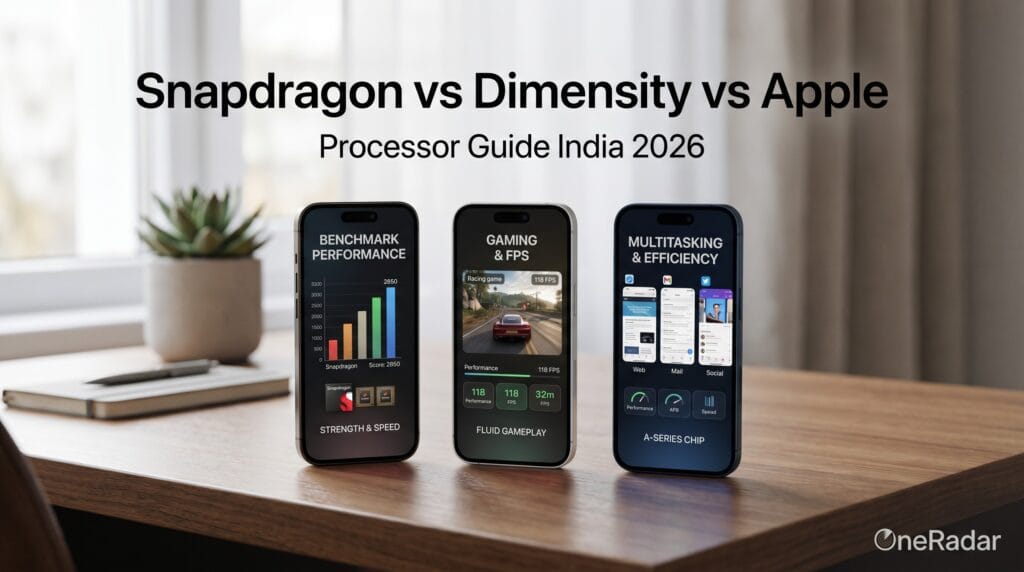
Processor in Smartphone Explained — Snapdragon vs Dimensity vs Apple Guide for India 2026
Understanding the processor in smartphone explained in plain language is the one thing that separates Indian buyers who always make the right phone purchase from those who overpay or end up with a slow phone within a year. Every smartphone specification sheet lists a processor — Snapdragon 8s Gen 3, Dimensity 8400 Ultra, Apple A18 — and most Indian buyers skip past it entirely because the names mean nothing without context.
This guide makes processor in smartphone explained simple. No engineering degree needed. By the end you will know exactly what a processor does, why the nanometer number matters, what Snapdragon vs Dimensity means for your daily use, and which processor tier to look for at every budget from ₹10,000 to ₹1,00,000 in India.
What Is a Processor in a Smartphone — The Plain Language Answer
The processor — also called the chipset or SoC (System on Chip) — is the brain of your smartphone. Everything your phone does, every calculation, every pixel drawn on screen, every photo processed, every message received — happens because the processor computed it.
When you open WhatsApp, the processor loads the app from storage into memory. When you take a photo, the processor processes the raw sensor data and applies noise reduction, colour correction, and sharpening to create the final image. When you play BGMI, the processor calculates every movement, every bullet trajectory, every frame of the game graphics you see on screen. When you charge your phone, the processor manages the charging algorithm to protect battery health.
A faster, more efficient processor means apps open quicker, games run smoother, photos process faster, and the battery lasts longer doing the same tasks. A slower, less efficient processor means lag, heat, poor battery life, and a phone that feels old before its time.
What Is Inside a Smartphone Processor — The Components That Matter
A smartphone processor is not a single unit — it is a collection of specialised components on a single chip called a System on Chip. Understanding each component explains the spec sheet.
CPU — Central Processing Unit
The CPU handles general computing tasks — running apps, processing user input, managing files, calculating game logic. Modern smartphone CPUs use a combination of high-performance cores and efficiency cores.
High-performance cores are powerful and fast but consume more battery. They activate when you open apps, play games, or do demanding tasks. Efficiency cores are slower but use very little power. They handle background tasks — syncing messages, checking notifications, playing music — while the high-performance cores sleep.
This hybrid architecture is why a modern ₹20,000 phone with 8 cores can have better battery life than an older phone with 4 powerful cores — the efficiency cores handle most of the work most of the time, waking the powerful cores only when genuinely needed.
GPU — Graphics Processing Unit
The GPU handles everything visual — game graphics, video playback, smooth animations, and the visual output of every app. A stronger GPU means smoother gaming at higher settings, faster video rendering, and more fluid animations throughout the phone interface.
In BGMI and COD Mobile, the GPU determines whether you can run at 90 FPS or 120 FPS, how detailed the game graphics are, and whether the frame rate stays consistent during intense firefights or drops suddenly. Qualcomm’s Adreno GPU (in Snapdragon chips) and ARM’s Mali and Immortalis GPUs (in Dimensity chips) are the two GPU families you encounter on Indian Android phones.
NPU — Neural Processing Unit
The NPU is the AI processor on the chip. It handles AI tasks — scene detection in camera, voice recognition, AI-powered features, real-time translation, and the on-device AI assistant features that every phone brand is adding in 2026.
A stronger NPU means faster, more capable AI features. It also means AI tasks happen on your phone rather than being sent to a server — important for privacy and for speed in areas with poor connectivity.
ISP — Image Signal Processor
The ISP processes every photo your camera takes. It receives raw sensor data — essentially a grid of light intensity measurements — and converts it into the finished photograph by applying noise reduction, white balance correction, HDR processing, and sharpening.
The quality of the ISP directly determines how good your camera photos look, regardless of how many megapixels the sensor has. A 50MP camera with a strong ISP produces better photos than a 108MP camera with a weak ISP. This is why phones with the same camera sensor produce different photo quality based on brand — different ISPs process the same data differently.
Modem — 5G and Network Connectivity
The modem handles all wireless communication — 5G, 4G, Wi-Fi, and Bluetooth. A more advanced modem supports more 5G frequency bands, achieving faster download speeds on Jio and Airtel 5G, and connects more efficiently in low-signal areas. For Indian buyers who use Jio or Airtel 5G, the modem’s band support directly determines whether you get 5G connectivity in your city.
What Does the Nanometer (nm) Number Mean
The nanometer number in processor specifications — 4nm, 3nm, 2nm — describes the size of the transistors inside the chip. This is one of the most important specifications and one of the most misunderstood.
A transistor is the basic switching element inside a chip — billions of them turning on and off to perform calculations. Smaller transistors mean more transistors fit on the same silicon area. More transistors means the chip can perform more calculations simultaneously. And because smaller transistors switch on and off with less energy, they produce less heat.
What this means practically for Indian buyers:
A Snapdragon 8s Gen 3 built on a 4nm process is more efficient than an older Snapdragon 865 built on a 7nm process. The 4nm chip performs more calculations per second with less heat and less battery consumption. This is why newer mid-range phones with 4nm processors can match the gaming performance of 2-year-old flagships with older, larger process nodes while using less battery.
The progression matters when comparing across generations. A 4nm chip from 2024 is more efficient than a 7nm chip from 2021. But two different 4nm chips from different manufacturers are not identical — the design of the chip within that process node determines performance as much as the node itself.
In 2026, the top chips use 3nm (Snapdragon 8 Elite Gen 5, Apple A19 Pro, Dimensity 9500) and even 2nm (Samsung Exynos 2600). All mainstream mid-range chips use 4nm. Budget chips use 4nm to 6nm.
The Three Processor Brands That Power Indian Phones
Qualcomm Snapdragon — Inside Most Premium Indian Phones
Qualcomm is an American semiconductor company that makes the Snapdragon processor family. Snapdragon chips are used by Samsung, OnePlus, Xiaomi (select models), iQOO, Motorola, and Sony. Visit Qualcomm’s official Snapdragon processor page to see their full chip lineup.
Snapdragon is organised into series that indicate market segment. The Snapdragon 4 series targets budget phones below ₹12,000. The Snapdragon 6 series targets phones in the ₹12,000 to ₹18,000 range. The Snapdragon 7 series targets mid-range phones from ₹18,000 to ₹35,000. The Snapdragon 8 series targets flagships above ₹40,000.
Within each series, the naming gets more specific. Snapdragon 7s Gen 3 is an entry point into the 7 series — good for 60 FPS gaming. Snapdragon 7 Gen 4 is a stronger mid-range chip. Snapdragon 8s Gen 3 is a near-flagship chip used in phones like the iQOO Neo 10R that delivers 120 FPS in BGMI. Snapdragon 8 Elite Gen 5 is the flagship chip powering the Vivo X300 Ultra and Samsung Galaxy S26.
Snapdragon’s Adreno GPU is specifically recognised for strong gaming performance — game developers often optimise for Adreno first, meaning Snapdragon phones can run BGMI at higher FPS settings that Dimensity phones of equivalent tier cannot always unlock immediately after launch.
MediaTek Dimensity — Inside Most Mid-Range Indian Phones
MediaTek is a Taiwanese company that makes the Dimensity processor family. Dimensity chips are used by Realme, Vivo, OPPO, POCO, Redmi (most models), and Infinix. MediaTek was considered a budget brand until 2022 — that perception is now completely outdated.
The Dimensity 9500, 9400, and 9300 chips directly compete with Qualcomm’s Snapdragon 8 Elite series. In benchmark tests, the Dimensity 9500 scores higher than the Snapdragon 8 Elite Gen 5 on AnTuTu. In gaming performance, both are exceptionally close. For Indian buyers considering mid-range phones — the Dimensity 8400 series in phones like the POCO X7 Pro and Realme GT 7T delivers performance that was flagship-exclusive two years ago.
The key advantage of Dimensity over Snapdragon is value. MediaTek licenses its chips to manufacturers at lower prices, meaning phone brands using Dimensity can offer the same performance tier at ₹3,000 to ₹5,000 lower price points than equivalent Snapdragon phones. The POCO X7 Pro at ₹23,999 with Dimensity 8400 Ultra delivers 90 FPS in BGMI — the same FPS tier as Snapdragon 8s Gen 3 phones costing ₹6,000 more.
Apple A-Series — Inside Every iPhone
Apple designs its own processors exclusively for iPhones. The Apple A19 Pro in the iPhone 17 Pro and A18 in the iPhone 17 standard model are built on 3nm and are the fastest smartphone processors available globally by most performance measures — particularly in single-core speed and energy efficiency.
Apple’s advantage comes from designing both the chip and the operating system simultaneously. iOS is optimised specifically for Apple chips in a way Android cannot replicate — resulting in iPhones feeling faster than their benchmark scores suggest and maintaining performance significantly longer than Android phones as software grows heavier over years.
The key limitation: Apple chips only work in iPhones. They are not available in any Android phone regardless of price.
Processor Tiers for Indian Buyers — What to Choose at Every Budget
Budget phones under ₹12,000:
At this price, most phones use Snapdragon 4s Gen 2, Dimensity 6300, or Helio G99. These chips handle WhatsApp, YouTube, UPI payments, and light games at 30 FPS comfortably. BGMI runs at 30 FPS on Low to Medium graphics. For basic daily use — calling, messaging, social media, light browsing — these chips are adequate. For gaming or heavy multitasking — save up to ₹15,000.
Mid-range phones ₹12,000 to ₹20,000:
Phones in this range use Snapdragon 7s Gen 3, Dimensity 7300, or Dimensity 7400. These chips handle BGMI at 60 FPS on HD settings comfortably. Multitasking between 5 to 6 apps is smooth. Camera processing is fast enough for everyday photos. This tier represents the sweet spot for most Indian buyers who want solid performance without overspending.
Upper mid-range ₹20,000 to ₹35,000:
Snapdragon 8s Gen 3, Dimensity 8400 Ultra, and Dimensity 8450 power phones in this range. This is the most competitive and most exciting price segment in Indian smartphones. BGMI at 90 FPS to 120 FPS is achievable. Camera quality reaches near-flagship levels. Battery management is excellent. For most Indian buyers who want the best possible performance per rupee — this is the range to target. See our best gaming phones under 30000 guide for the best phones in this tier.
Flagship above ₹40,000:
Snapdragon 8 Elite Gen 5 and Dimensity 9500 power Indian flagship phones above ₹40,000. These chips deliver 120 FPS gaming in all supported titles, the fastest camera processing available, the most capable AI features, and the smoothest performance under any load. AnTuTu scores above 2 million. The performance advantage over upper mid-range chips is real but diminishing for everyday use — the gap is most visible in camera processing, sustained heavy gaming, and AI feature quality.
Snapdragon vs Dimensity — Which Should You Choose in India
This is the question every Indian buyer asks when comparing phones at the same price. Here is the honest verdict for 2026.
Choose Snapdragon if: You play BGMI competitively and want access to the highest FPS settings as soon as the game updates. Snapdragon’s Adreno GPU receives BGMI performance certifications earlier than Dimensity — meaning 90 FPS or 120 FPS support unlocks on Snapdragon phones first and on Dimensity phones weeks or months later. The iQOO Neo 10R with Snapdragon 8s Gen 3 supports 120 FPS in BGMI — the POCO X7 Pro with Dimensity 8400 Ultra does not yet.
Choose Dimensity if: You want the best value per rupee and are not specifically dependent on BGMI’s FPS certification timing. Dimensity phones deliver equivalent daily performance, better benchmark scores at equivalent prices, and marginally better battery life in daily use tasks. The POCO X7 Pro at ₹23,999 with Dimensity 8400 Ultra costs ₹6,000 less than the iQOO Neo 10R while delivering comparable performance for everything except the 120 FPS BGMI certification.
For non-gaming use: Choose either. The daily experience difference between Snapdragon and Dimensity at the same price tier is negligible for WhatsApp, YouTube, Instagram, UPI, and standard Indian app usage. Both are excellent in 2026. The BGMI FPS certification is the only practically significant difference for most Indian buyers.
What Is AnTuTu Score — Should You Trust It
AnTuTu is a benchmark application that runs a series of performance tests and produces a single score. Higher score means the chip performs more calculations per second across its benchmark tests. AnTuTu scores are frequently used in Indian smartphone marketing to compare performance.
The honest assessment: AnTuTu scores are useful for comparing chips within the same generation but misleading for comparing across generations or for predicting real-world performance. A Dimensity 9500 scoring 4.01 million on AnTuTu does not mean it is twice as fast for daily use as a Snapdragon 8s Gen 3 scoring approximately 1.3 million — the tasks Indian users do daily are nowhere near as demanding as AnTuTu’s synthetic tests.
Real-world performance depends on software optimisation — how well the phone brand has tuned the chip for daily use — as much as the chip’s raw capability. A Snapdragon 8 Gen 3 phone with poor software optimisation feels slower in daily use than a Dimensity 8400 phone with excellent software tuning, despite higher benchmark scores. Software updates often improve performance on specific chips over time regardless of hardware.
Use AnTuTu as one input — not the only input — when comparing phones. For gaming phones specifically, the BGMI-certified FPS tier and real-world user reviews from Indian BGMI players matter more than benchmark numbers.
Which Phone Should You Buy Based on Processor Alone
For students and light users who want value: any phone with Dimensity 7300 or Snapdragon 7s Gen 3 in the ₹12,000 to ₹18,000 range. See our best phone under 15000 guide.
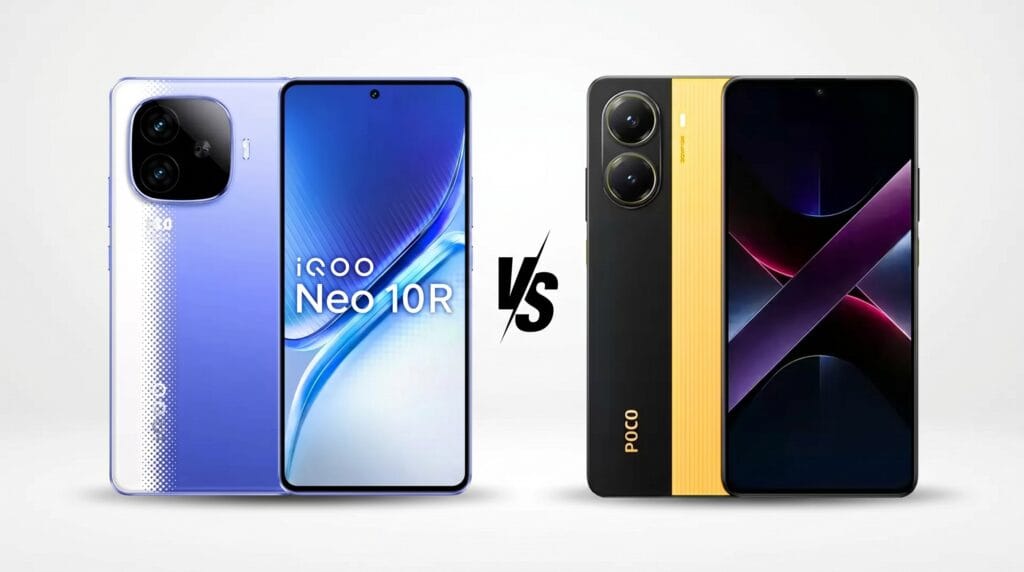
For BGMI players who want 90 FPS: POCO X7 Pro (Dimensity 8400 Ultra, ₹23,999) or iQOO Neo 10R (Snapdragon 8s Gen 3, ₹29,999) — both covered in our iQOO Neo 10R vs POCO X7 Pro comparison.
For BGMI players who want 120 FPS: iQOO Neo 10R (Snapdragon 8s Gen 3) is the only phone under ₹30,000 that currently delivers 120 FPS in BGMI.
For iPhone users: Apple A18 in the iPhone 17 standard or Apple A18 Pro in the iPhone 17 Pro — both are the best-performing smartphone chips for iOS.
Frequently Asked Questions
What is a processor in smartphone explained simply?
A processor in smartphone is the chip that runs every function on your phone — opening apps, processing camera photos, running games, managing battery charging, and handling every calculation the phone performs. It is called an SoC (System on Chip) because it combines multiple specialised processors on a single chip — the CPU for general tasks, the GPU for graphics and gaming, the NPU for AI features, the ISP for camera processing, and the modem for 5G and wireless connectivity. A faster, more efficient processor makes apps open quicker, games run smoother, photos process faster, and battery last longer.
What is the difference between Snapdragon and Dimensity processors?
Snapdragon processors are made by Qualcomm and are used in Samsung, OnePlus, iQOO, and Motorola phones. Dimensity processors are made by MediaTek and are used in Realme, Vivo, OPPO, POCO, and Redmi phones. In 2026, both deliver excellent performance at equivalent price tiers. The main practical difference for Indian buyers is BGMI FPS certification — Snapdragon’s Adreno GPU receives high-FPS gaming certifications from Krafton earlier than Dimensity. For competitive BGMI players who want 120 FPS, Snapdragon is the safer choice. For all other use cases, Dimensity often provides slightly better value per rupee.
What does nm mean in processor specifications?
nm stands for nanometer — the size of the transistors inside the processor chip. Smaller nm means smaller transistors, which means more transistors fit on the same chip size, which means better performance with less heat and less battery consumption. A 4nm processor is more efficient than a 7nm processor — it does more work per unit of power consumed. In 2026, flagship smartphone processors use 3nm (Snapdragon 8 Elite Gen 5, Apple A19 Pro, Dimensity 9500) and mainstream mid-range processors use 4nm. A smaller nm number always indicates a newer, more advanced fabrication process.
Which processor is best for BGMI in India in 2026?
The best processor for BGMI in India in 2026 is the Snapdragon 8s Gen 3 found in phones like the iQOO Neo 10R. It is the only processor under ₹30,000 that supports 120 FPS gameplay in BGMI following Krafton’s certification update. For 90 FPS BGMI, the Dimensity 8400 Ultra (POCO X7 Pro) and Dimensity 8450 (OPPO K13 Turbo) both deliver stable 90 FPS at lower prices. For 60 FPS comfortable BGMI gaming, any Snapdragon 7 Gen 3 or Dimensity 7400 phone in the ₹18,000 to ₹22,000 range is sufficient.
Is Snapdragon always better than Dimensity for Indian phones?
No — Snapdragon is not always better than Dimensity. In 2026, Dimensity processors at the same price tier deliver comparable or better benchmark performance than Snapdragon. The Dimensity 9500 outscores the Snapdragon 8 Elite Gen 5 on AnTuTu. Dimensity phones often provide marginally better battery life in daily use. The one area where Snapdragon maintains a consistent advantage is gaming FPS certification — Adreno GPU support for high-FPS modes in BGMI and COD Mobile tends to arrive earlier on Snapdragon phones. For most Indian buyers who are not specifically competitive BGMI players — Dimensity provides excellent value and there is no compelling reason to specifically seek Snapdragon.
What processor should I look for when buying a phone under ₹15,000 in India?
Under ₹15,000 in India in 2026, look for a phone with Dimensity 7300, Dimensity 7400, Snapdragon 7s Gen 3, or Helio G99 processor. These chips handle all daily Indian phone usage — WhatsApp, YouTube, Instagram, UPI, casual gaming — comfortably. Avoid phones with processors older than 3 generations or with 4GB RAM regardless of processor. The Helio G99 specifically is a capable chip that handles moderate gaming well in the ₹12,000 to ₹14,000 range.
What does GPU mean in a smartphone processor?
GPU stands for Graphics Processing Unit. The GPU inside a smartphone processor handles all visual output — game graphics, smooth animations, video playback, and the visual rendering of every app. A stronger GPU means smoother gaming at higher settings, faster video rendering, and more fluid interface animations. In gaming phones, the GPU is the most important processor component — it determines the maximum FPS achievable in BGMI, COD Mobile, and other graphics-intensive games. Qualcomm’s Adreno GPU family powers Snapdragon chips. ARM’s Mali and Immortalis GPU families power Dimensity chips.
Processor specifications in this guide are verified from Qualcomm’s official product pages, MediaTek’s official website, Apple’s developer documentation, and verified benchmark sources as of May 2026. Processor performance varies by phone model, software optimisation, and thermal management — benchmark scores are indicative and real-world performance may differ.

Chandu Patel is a tech writer at OneRadar covering smartphones, gadgets, and consumer electronics in India. He writes honest buying guides, reviews, and price comparisons to help Indian buyers make smarter choices without overspending.