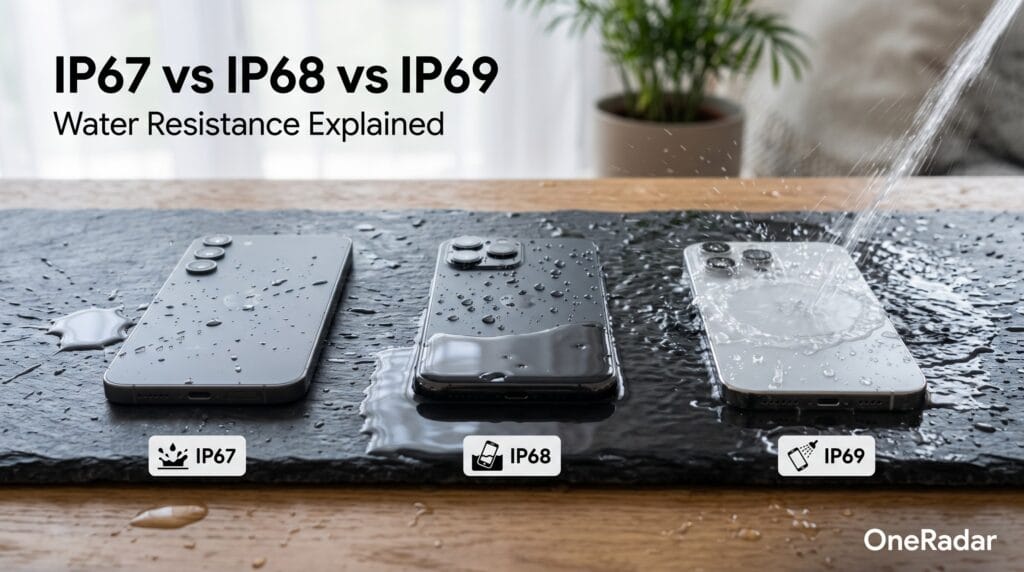
Every smartphone specification sheet above ₹12,000 in India now mentions an IP rating — IP67 vs IP68 vs IP69 — and most Indian buyers either ignore it entirely or assume higher numbers mean the phone is completely waterproof. Neither assumption is correct. Understanding the difference between IP67 vs IP68 vs IP69 directly affects how confidently you can use your phone near water, in the Indian monsoon, at the beach, and even in a swimming pool — and it affects whether your warranty covers water damage when something goes wrong.
This guide explains the IP67 vs IP68 vs IP69 difference completely — in plain language, without engineering jargon, with specific Indian usage context for monsoon season, coastal cities, swimming pools, and daily use near water.
What Does IP Stand For
IP stands for Ingress Protection — an international classification system defined by the IEC 60529 international standard. It measures how well a device resists the entry of solid particles (dust, sand) and liquids (water) into its internal components.
Every IP rating has exactly two numbers after the letters IP. The first number rates solid particle protection. The second number rates liquid protection. Both numbers matter — but for smartphones in India, the second number (water protection) is what most buyers focus on correctly.
The first digit goes from 0 to 6. A rating of 6 — which all modern sealed smartphones achieve — means completely dust-tight. No dust particle of any size can enter the device. This is why you never see a modern flagship phone with less than IP6X for the first digit — glass sandwich construction makes dust sealing straightforward.
The second digit goes from 0 to 9. This is the number that actually matters for Indian buyers and where IP67, IP68, and IP69 all differ significantly.
What the Second Number Means — Water Protection Levels
Understanding each level of the second digit in the IP67 vs IP68 vs IP69 comparison requires knowing what each number’s test conditions actually involve.
Level 4 — Splashproof (IPX4): Protection against water splashes from any direction. Found on budget earphones and some entry-level phones. Handles light rain but not submersion.
Level 5 — Water jet resistant (IPX5): Protection against low-pressure water jets from any direction. A phone with IP65 survives a garden hose spray from a distance of 3 metres for 1 minute. Does not protect against submersion.
Level 6 — High-pressure water jet resistant (IP66): Protection against powerful water jets — 12.5 litres per minute at 100 kPa pressure from any direction for 3 minutes. More protective than IP65 but still not submersion-rated.
Level 7 — Submersion up to 1 metre (IP67): Protection against continuous submersion in water up to 1 metre depth for 30 minutes. This is the minimum for phones marketed as water-resistant. Handles rain, splashes, dropped in a bucket, and shallow water.
Level 8 — Submersion beyond 1 metre (IP68): Protection against continuous submersion beyond 1 metre depth — the exact depth is specified by the manufacturer individually. Most Android phones specify 1.5 metres for 30 minutes. Apple iPhones specify 6 metres for the Pro models. This is the most common premium water resistance rating in India.
Level 9 — High-pressure hot water jets (IP69): Protection against high-pressure water jets at close range — 80°C water at 100 bar pressure sprayed from 10 to 15 centimetres distance. IP69 was originally designed for industrial equipment that requires steam cleaning and sanitising. In smartphones, it means the device survives a direct high-pressure shower spray.
IP67 vs IP68 vs IP69 — The Direct Comparison
Here is the specific difference between each rating in the context of how Indian buyers actually use their phones.
IP67 — Entry Level Water Resistance
An IP67 phone can be submerged in still fresh water up to 1 metre deep for 30 minutes. In Indian daily use this means: safe in the monsoon, safe if dropped in a bucket or sink, safe in light rain, safe for brief bathroom use. It does not mean safe for swimming, safe in a pool, or safe in heavy high-pressure shower spray.
Phones with IP67 in India in 2026 include several phones in the ₹15,000 to ₹25,000 range. The Samsung Galaxy M series and select Redmi Note models carry IP67 ratings.
IP68 — The Right Standard for Most Indian Buyers
An IP68 phone can be submerged beyond 1 metre — typically 1.5 metres for Android phones and up to 6 metres for iPhones — for 30 minutes in controlled conditions. In Indian daily use this means everything IP67 covers, plus: safe for a swimming pool session, safe for snorkelling in fresh water, safe in a heavy shower, and safe for deliberate brief underwater photography.
IP68 is the standard that makes the most practical difference for Indian buyers. The jump from IP67 to IP68 in real-world use is significant — IP68 gives genuine confidence in and around water, not just protection against accidental splashes.
Phones with IP68 in India in 2026 include the Samsung Galaxy S26 series, iPhone 17 series, OnePlus Nord 6, POCO X7 Pro, Google Pixel 10 series, and most flagships above ₹30,000.
IP69 — Industrial Certification That Helps But Is Misunderstood
An IP69 phone can withstand high-pressure hot water jets directly on its surface — 80°C water at 100 bar pressure from 10 to 15 centimetres away. This test was designed for industrial machinery that requires sanitising with steam cleaners and industrial pressure washers.
The key misunderstanding Indian buyers have about IP69: it does not mean the phone is more submersible than IP68. The IP69 test is about high-pressure jet resistance — not depth. A phone rated IP69 but not IP68 could potentially be damaged by submersion while surviving a shower spray. This is why premium phones increasingly list IP68 and IP69 together — they test for both submersion depth and high-pressure jet resistance.
The OnePlus 13 and OnePlus 15 are among the first mainstream smartphones to achieve IP69 ratings in India. The OnePlus Nord 6 carries IP66, IP68, IP69, and IP69K certifications — a combined rating that covers virtually every water exposure scenario.
The Ratings That Appear Together — IP66 + IP68 + IP69
Modern premium smartphones from Samsung, OnePlus, and Apple increasingly list multiple IP ratings simultaneously because each test covers different scenarios and none covers all scenarios alone.
IP66 certifies resistance to powerful water jets from any direction. IP68 certifies resistance to deep submersion. IP69 certifies resistance to high-pressure close-range spray. A phone rated only IP68 may technically fail the IP69 test — not because it cannot be submerged, but because it was not tested against high-pressure jets. Brands are now testing and certifying all three to give buyers a complete picture.
When you see IP66 + IP68 + IP69 listed together — as on the OnePlus Nord 6 reviewed on our site — this means the phone was independently tested and certified for all three scenarios. This combined rating represents the most comprehensive real-world water protection available.
The Three Things IP Ratings Do NOT Cover — Most Important Section
This is the information most Indian buyers never read — and it is the information that matters most when something goes wrong.
IP ratings do not cover saltwater. Every IP rating is tested in fresh water under laboratory conditions with temperature controlled between 15°C and 35°C. Salt water — from the ocean, from sweat, from coastal rain — is significantly more corrosive than fresh water. Salt crystals lodge in seams and seals and accelerate corrosion of the metallic components inside the phone. Using an IP68 phone for regular sea swimming or leaving it exposed to coastal salt air repeatedly will degrade the seals over months. If you use your phone at the beach or in the sea — rinse it with fresh water immediately after and dry it thoroughly.
IP ratings do not cover swimming pool water. Chlorinated pool water has a similar problem to salt water — the chemicals are corrosive and are not part of the IP test conditions. An IP68 phone dropped briefly in a pool once will almost certainly survive. Regularly swimming with your IP68 phone for 30-minute sessions multiple times per week will degrade the seals much faster than the rating implies.
IP ratings degrade over time. The seals that provide water resistance are made of rubber gaskets and adhesive bonding. These degrade with every seal compression — every time you insert a SIM card, every time the phone flexes slightly in your pocket, every time the phone gets hot and cools down. A phone that was IP68 on launch day has less effective water resistance after 12 months of daily use and significantly less after 24 months. This is why Google and Apple add “under controlled laboratory conditions” disclaimers to their IP rating claims.
Water damage is almost never covered by warranty in India. This is the most important practical point. Despite advertising IP68 ratings prominently, Samsung, Apple, OnePlus, and virtually every other brand explicitly excludes liquid damage from their standard warranty. If your IP68 phone gets water-damaged and you take it to a service centre — they will check the phone’s internal liquid damage indicator (a small moisture-sensitive sticker that turns red when wet) and deny the warranty claim if it has been triggered. Your IP rating is protection against accidental water exposure — not an insurance policy against water damage.
IP Ratings on Indian Phones at Every Budget
Under ₹15,000 — Usually No IP Rating or IP52/IP54
Most phones in this price range have no official IP certification at all. Some carry informal splash resistance claims without third-party certification. A phone without an IP rating should be treated as having no water resistance — handle it accordingly in Indian monsoon conditions.
₹15,000 to ₹25,000 — IP67 Becomes Common
Phones like the Samsung Galaxy M35 5G carry IP67 ratings. This is adequate for Indian monsoon use and daily protection against accidental water contact. You should not deliberately submerge an IP67 phone or use it in heavy rainfall for extended periods.
₹25,000 to ₹40,000 — IP68 Standard
Most phones in this range now carry IP68 as standard. The POCO X7 Pro at ₹23,999 carries IP68 + IP69 — exceptional water resistance for its price. The Realme GT 7T at ₹28,999 does not have an official IP rating — showing that price does not always guarantee IP certification. Always check the specific phone’s IP rating rather than assuming based on price.
Above ₹40,000 — IP68 and Combined Ratings
Every flagship above ₹40,000 in India in 2026 carries at least IP68. The Samsung Galaxy S26 Ultra carries IP68. The iPhone 17 Pro Max carries IP68 with 6-metre submersion depth — the deepest consumer phone rating in India. The OnePlus Nord 6 carries the combined IP66 + IP68 + IP69 + IP69K — the most comprehensive water protection certification on a mainstream smartphone in India.
What IP Rating Do You Actually Need — Indian Buyer Guide
For daily Mumbai, Chennai, or Goa monsoon use: IP67 is sufficient. You need protection against rain, accidental splashes, and occasional drops near water — all covered by IP67.
For swimming, beach trips, or water sports: IP68 minimum. The deeper submersion tolerance and better seal quality of IP68 gives genuine confidence for aquatic activities in fresh water. For regular sea swimming — rinse the phone with fresh water after every use regardless of rating.
For construction workers, field workers, outdoor professionals: Look for combined IP66 + IP68 ratings. IP66’s jet resistance protects against high-pressure water encountered in outdoor professional environments. IP68 protects against accidental submersion.
For coastal city residents — Kochi, Vizag, Mumbai, Chennai: IP68 recommended. The salt air in coastal cities accelerates seal degradation even without direct water contact. The better quality seals in IP68-certified phones degrade more slowly in salt air conditions.
For casual daily use in Tier 2 cities without much water exposure: Any IP rating — or no IP rating — is adequate if you are careful with the phone. An IP67 or IP68 rating is nice to have but not necessary if your daily use does not involve water exposure beyond light rain.
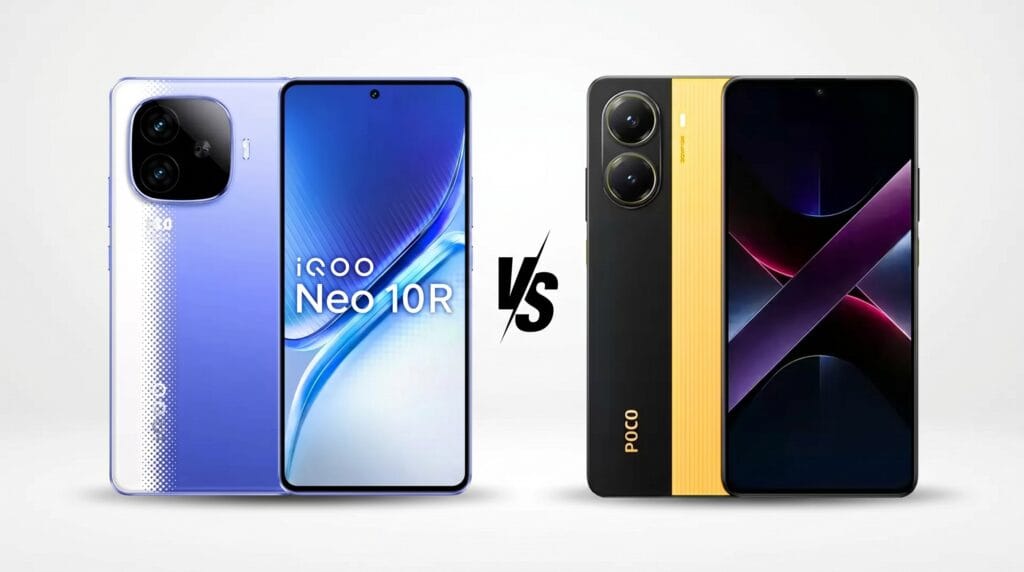
For information on which specific phones have the best IP ratings at each price point, see our best gaming phones under 30000 guide which covers water resistance for every reviewed phone, and our iQOO Neo 10R vs POCO X7 Pro comparison which covers the IP68 + IP69 advantage of the POCO X7 Pro in detail.
Common Myths About IP Ratings — Busted
Myth: Higher IP number means better waterproof phone overall. False. IP69 tests jet resistance — not submersion depth. An IP69-only phone could be less submersion-resistant than an IP68 phone. The best protection is combined IP68 + IP69 certifications.
Myth: My IP68 phone is safe in the sea. False. IP68 is tested in fresh water only. Salt water corrodes seals faster and voids warranty claims. Rinse with fresh water immediately after any salt water exposure.
Myth: My IP rating means water damage is covered under warranty. False. Every major brand explicitly excludes liquid damage from warranty in India. The IP rating is tested protection — not insurance. Keep your phone away from water whenever possible even with an IP68 rating.
Myth: A phone that survived water once will always survive water. False. IP seals degrade over time. A phone that was IP68 rated at launch has progressively less effective water resistance as the rubber seals and adhesives age with use.
Myth: Phones without IP ratings will always be damaged by water. Not necessarily. Many phones without official IP certification are assembled with similar seals but simply were not sent for independent testing — usually to keep manufacturing costs down. They may have reasonable splash resistance in practice. However, without certification there is no guarantee and no warranty recourse.
Frequently Asked Questions
What is the difference between IP67 vs IP68 vs IP69?
IP67 means the phone can be submerged in fresh water up to 1 metre deep for 30 minutes. IP68 means the phone can be submerged beyond 1 metre — typically 1.5 metres for Android phones and up to 6 metres for iPhones — for 30 minutes. IP69 means the phone can withstand high-pressure hot water jets at 100 bar pressure from 10 to 15 centimetres — a test designed for industrial steam cleaning scenarios. IP69 does not mean better submersion resistance than IP68. The most comprehensive protection is combined IP68 + IP69 certification which covers both deep submersion and high-pressure jet scenarios.
Is IP68 enough for Indian monsoon use?
Yes — IP68 is more than sufficient for Indian monsoon use. Even IP67 covers the monsoon scenario comfortably — it protects against submersion up to 1 metre for 30 minutes, which handles heavy rainfall, accidental puddle drops, and splashing. IP68 adds additional depth tolerance useful for swimming and more deliberate water activities. For most Indian buyers facing monsoon season — IP67 provides adequate protection and IP68 provides excellent protection with room for more adventurous water use.
Does IP68 mean the phone is completely waterproof?
No — IP68 means the phone was tested and certified to survive submersion in fresh water up to the manufacturer’s specified depth (typically 1.5 metres) for 30 minutes under controlled laboratory conditions. It does not mean the phone is waterproof in all conditions. Saltwater, pool chlorine, high temperatures, and physical damage to seals can all compromise the protection. Water damage is not covered under warranty on IP68 phones — every major brand explicitly excludes liquid damage from their standard India warranty.
Which phones in India have IP69 rating in 2026?
As of May 2026, the OnePlus 13, OnePlus 15, and OnePlus Nord 6 are among the mainstream smartphones available in India with IP69 certification. The OnePlus Nord 6 carries the most comprehensive rating — IP66 + IP68 + IP69 + IP69K — covering jet resistance, deep submersion, high-pressure sprays, and high-pressure high-temperature jet resistance simultaneously. Samsung Galaxy S26 series carries IP68. iPhones carry IP68 with depth specifications up to 6 metres on Pro models. POCO X7 Pro at ₹23,999 carries IP68 + IP69 — the best water resistance available under ₹25,000 in India.
Why does my IP68 phone show no water damage but the service centre denied my warranty claim?
Every smartphone has a Liquid Damage Indicator (LDI) — a small sticker inside the phone near the charging port or SIM tray slot that permanently changes colour when it detects moisture. Service centres check this sticker first. If the LDI has turned red — indicating the phone was exposed to moisture internally — the warranty is denied regardless of IP rating. The IP rating does not change the warranty exclusion for liquid damage. This is standard policy across Samsung, Apple, OnePlus, Xiaomi, and all other brands in India.
Is there an IP rating higher than IP69?
IP69 and IP69K are the highest standard water protection ratings in the IEC 60529 system. IP69K is a German automotive standard (DIN 40050-9) that tests against 80°C water at 100 bar from 10 to 15 centimetres — essentially the same test as IP69 but with slightly more stringent requirements. Some phones list both IP69 and IP69K as the OnePlus Nord 6 does. Beyond these, some rugged phones use military standards like MIL-STD-810H that cover a broader range of environmental conditions including temperature extremes, altitude, and vibration in addition to water resistance.
Do budget phones under ₹15,000 in India have IP ratings?
Most phones under ₹15,000 in India do not have official IP certifications. IP certification requires paying for independent third-party lab testing which adds manufacturing cost. Budget brands omit this certification to keep prices low. Some budget phones have informal splash resistance from their sealed construction but without certification there is no guarantee and no warranty protection. Phones above ₹20,000 increasingly include IP67 or IP68 as standard — the POCO X7 Pro at ₹23,999 with IP68 + IP69 is among the best water resistance value available in India.
IP rating information in this guide is based on the IEC 60529 international standard and verified manufacturer specifications as of May 2026. Real-world water resistance depends on seal condition, water type, temperature, and pressure — IP ratings are laboratory test results and do not constitute waterproofing guarantees. Water damage is excluded from standard warranties across all major smartphone brands in India.