Infinix GT 50 Pro — Price in India, Launch Date and Full Specifications 2026
Infinix just launched the phone that every competitive BGMI player on a budget has been waiting for — and it is more serious than anyone expected. The Infinix GT 50 Pro went global on April 24, 2026, with three features that no other phone in its expected price range offers together: 144 FPS BGMI support, dual pressure-sensitive physical shoulder triggers, and a Micro-Pump HydroFlow liquid cooling system with a 6,437mm² diaphragm — the largest cooling surface Infinix has ever built into a phone.
This is not just another mid-range gaming phone with a gaming-aesthetic design sticker slapped on it. The GT 50 Pro is built from the ground up for mobile esports — and if Infinix prices it in India anywhere close to the GT 30 Pro’s ₹24,999 launch price, it becomes the most disruptive gaming phone under ₹30,000 in India in 2026.
Here is everything confirmed about the Infinix GT 50 Pro — verified specs, what the India launch situation actually looks like, and an honest verdict on whether this is the gaming phone to wait for.
Infinix GT 50 Pro — India Launch Date
The Infinix GT 50 Pro had its global launch on April 24, 2026. It went on sale first in Indonesia on April 25, 2026.
India launch status: Infinix has not officially announced an India launch date as of April 26, 2026. However, Infinix launched the GT 30 Pro in India in June 2025 — approximately 2 to 3 months after its global reveal. If the same pattern holds, India can expect the GT 50 Pro between June and August 2026.
Infinix’s True Rippers BGMI esports partnership — which started with the GT 30 Pro in India — is expected to continue with the GT 50 Pro. The GT 30 Pro was Krafton-certified for 120 FPS in BGMI, and the GT 50 Pro pushes that ceiling to 144 FPS — making an India launch with BGMI certification highly likely.
This page will be updated the moment Infinix India announces a launch date or price.
Infinix GT 50 Pro — Expected Price in India
Infinix has not confirmed India pricing. Based on available data:
The Indonesia launch price is Rp 6,999,000 (~₹38,295) for 12GB + 256GB and Rp 7,999,000 (~₹43,685) for 12GB + 512GB. Indonesia prices are typically higher than India prices for Infinix due to import duties and local taxes in that market.
The GT 30 Pro launched in India at ₹24,999 — considerably cheaper than its global pricing. Infinix India has historically priced GT series phones aggressively for the Indian market.
Expected India price: ₹27,999 to ₹31,999 for the base 12GB + 256GB variant based on Infinix’s India pricing patterns and the GT 30 Pro’s India launch precedent. The 12GB + 512GB variant may come around ₹33,999 to ₹35,999 if offered in India.
These are estimates — not confirmed prices. Do not pre-order or commit to any price you see on third-party sites before Infinix India makes an official announcement.
Infinix GT 50 Pro — Full Confirmed Specifications
Every specification below is confirmed from Infinix’s official global product page :
Display: 6.78-inch flat AMOLED panel with 1.5K resolution (1224 × 2720 pixels), 144Hz refresh rate, 10-bit colour, 2,304Hz PWM dimming, 700 nits typical brightness, 1,600 nits HBM, and 4,500 nits peak brightness. Protected by Corning Gorilla Glass 7i. The flat panel is a deliberate gaming choice — curved displays cause accidental touches on the edges during intense gaming sessions, something competitive BGMI players know frustratingly well.
Touch Sampling: 330Hz standard touch sampling with 2,800Hz instant touch in gaming mode. At 2,800Hz, the screen detects your touch every 0.36ms — the fastest touch response available on any Infinix phone.
Processor: MediaTek Dimensity 8400 Ultimate built on a 4nm process, paired with a Mali-G720 MC7 GPU. The Dimensity 8400 Ultimate is the top variant of MediaTek’s 8400 chip — clocked higher and thermally tuned differently from the standard Dimensity 8400 and 8400 Ultra found in phones like the POCO X7 Pro. It is the same chip class that powers the Realme GT 7T.
RAM and Storage: 12GB LPDDR5X RAM on all variants. 256GB or 512GB UFS 4.1 storage — UFS 4.1 is the latest and fastest storage standard available on any smartphone in 2026, faster than the UFS 4.0 found on competing phones like the POCO X7 Pro.
Rear Cameras: 50MP primary sensor with OIS and EIS, 8MP ultrawide lens. The camera setup is honest — this is a gaming phone and Infinix has not pretended otherwise by stuffing an unreliable periscope telephoto for marketing purposes.
Front Camera: 13MP.
Battery: 6,500mAh single-cell battery with 45W wired fast charging and 30W wireless charging (requires the optional GT MagCharge Cooler 2.0 accessory for wireless charging). Reverse charging supported.
Software: Android 16 with XOS 16. 5-year software support commitment — the longest software update promise Infinix has ever made and one of the longest in this price segment. For a gaming phone bought today, 5 years of updates means it stays current until 2031.
Connectivity: Wi-Fi 6, Bluetooth 5.4, NFC, USB Type-C, dual-band GPS. NFC enables Google Pay tap payments — confirmed present, unlike the iQOO Neo 10R which skips NFC.
Build: 198g weight, 8.2mm thickness. The 8.2mm slim profile for a 6,500mAh gaming phone is genuinely impressive — most phones with comparable batteries run above 9mm.
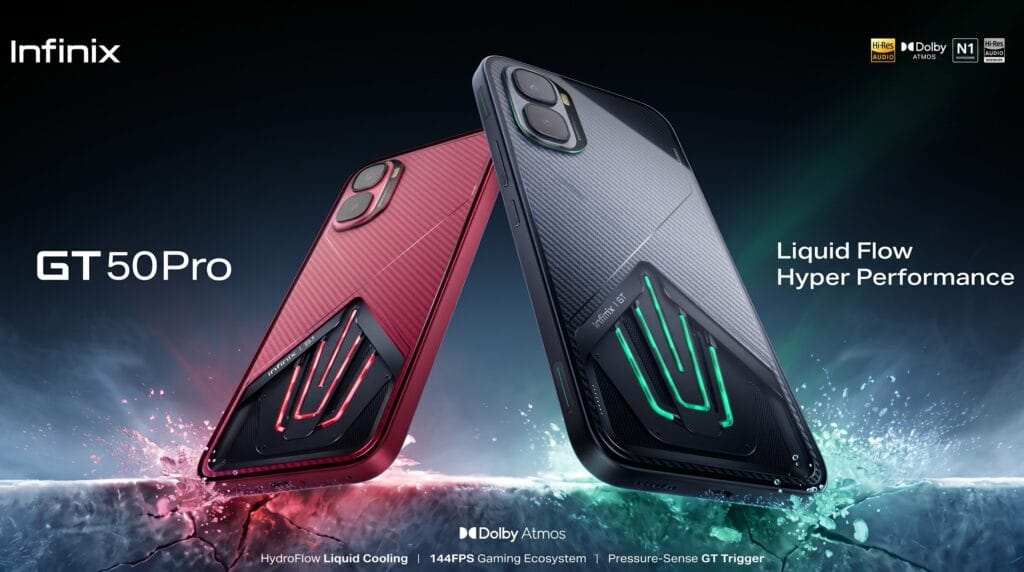
Colours: Black Abyss, Red Blaze, Silver Glacier.
The Three Features That Make the GT 50 Pro Different
1. Dual Pressure-Sense GT Triggers — The Console Feature No One Else Has at This Price
The GT 50 Pro has physical shoulder trigger buttons built into the right edge of the phone — and they are not a basic capacitive touch zone like older gaming phones. These are genuine mechanical triggers rated for 3 million+ presses with 10 levels of pressure sensitivity and 20ms response latency.
Here is what 10 pressure levels actually means in BGMI: a light press on the L2 trigger could be mapped to ADS (aim down sights), while a full press maps to firing — replicating the two-stage trigger feel of a console controller. Most phones with “trigger zones” are just capacitive touch areas divided into two zones. The GT 50 Pro detects how hard you are pressing and responds differently — this is significantly more sophisticated.
The triggers support up to 8 mapping points — each trigger can be assigned to 8 different on-screen actions. You can map BGMI’s fire button, ADS, jump, crouch, and grenade throw across both triggers, freeing your thumbs to focus entirely on movement and aim. A separate ZoneTouch Master button on the left edge adds another physical input point.
Beyond gaming, the triggers double as camera zoom sliders and app shortcuts — practical features that make them useful outside gaming sessions too.
No other phone in India under ₹35,000 has pressure-sensitive physical triggers. The OPPO K13 Turbo had a built-in fan but no triggers. The iQOO Neo 10R and POCO X7 Pro have software gaming modes but no physical controls. This is the GT 50 Pro’s most differentiated feature.
2. Micro-Pump HydroFlow Liquid Cooling — The Real Solution to Gaming Heat
Most gaming phones claim “liquid cooling” through a vapour chamber — a sealed flat copper chamber with coolant that passively distributes heat. The GT 50 Pro goes further with an active micro-pump liquid cooling system.
The 6,437mm² diaphragm — the largest Infinix has ever used — covers 100% of the core processor heat zones. A piezoelectric ceramic micro-pump actively circulates coolant at 6.5ml per minute through a loop that includes the processor, power delivery module, and display driver — not just the processor alone.
The difference between active and passive cooling in gaming phones is temperature. In our earlier coverage of the OPPO K13 Turbo, we noted that its active fan brought gaming temperature down from 46°C to 35°C. A micro-pump liquid loop operates differently from a fan — it removes heat from the source rather than blowing air over it — and is expected to provide similar or better temperature control without the fan noise.
The optional GT MagCharge Cooler 2.0 accessory adds another layer. It attaches magnetically to the back and provides 12W thermoelectric (TEC) cooling — an electronic cooling system that actively lowers the back panel temperature. It also enables wireless bypass charging — directing power from the charger directly to the phone’s motherboard rather than through the battery, meaning the battery stays at its current charge level during gaming while the phone runs off external power. This prevents the charging-while-gaming heat problem entirely and protects battery health during long sessions.
3. Dimensity 8400 Ultimate + 144 FPS BGMI — The Number That Matters
The Dimensity 8400 Ultimate enables native 144 FPS gameplay in supported titles including Call of Duty: Mobile and Mobile Legends. For BGMI, the GT 30 Pro was Krafton-certified for 120 FPS — and Infinix has indicated the GT 50 Pro’s certification target is 144 FPS in BGMI, pending Krafton’s certification update.
This is the most competitive gaming specification available on any phone under ₹35,000 in India right now. The iQOO Neo 10R — our current top pick for gaming under ₹30,000 — supports 120 FPS in BGMI. If the GT 50 Pro achieves Krafton-certified 144 FPS at a similar or lower price, it directly challenges the Neo 10R’s position. Check our best gaming phones under 30000 guide — when the GT 50 Pro launches in India, this list will be updated with its position.
OneRadar Pre-Launch Rating
OneRadar Specs Rating: 8.9/10
This is a pre-launch rating based on specifications only — not real-world testing. The 144 FPS target, dual-pressure physical triggers, active liquid cooling, UFS 4.1 storage, 5-year software support, and NFC at an expected price of ₹27,999 to ₹31,999 represent a genuinely impressive package on paper.
Strengths on paper
| What Impresses | Why It Matters |
|---|---|
| Dual pressure-sense triggers — 10 levels, 20ms latency | Only gaming phone under ₹35,000 with real mechanical triggers |
| 144 FPS BGMI target | 20% more frames than iQOO Neo 10R’s 120 FPS |
| Micro-pump HydroFlow — 6,437mm² active cooling | Actively removes heat vs passive vapour chambers |
| UFS 4.1 storage | Fastest storage on any phone in this price range |
| 5-year software support | Longest update commitment in this price segment |
| NFC included | Google Pay tap payments — absent on iQOO Neo 10R |
| 8.2mm thickness with 6,500mAh battery | Slimmer than most gaming phones at this battery size |
Concerns before launch
| Concern | Why It Matters |
|---|---|
| India launch not yet confirmed | May arrive 2 to 3 months after global launch — or may not come at all |
| Only 13MP front camera | Significantly behind iQOO Neo 10R’s 32MP selfie camera |
| Only 45W wired charging | Slower than POCO X7 Pro’s 90W and Realme GT 7T’s 120W |
| No official BGMI 144 FPS certification yet | 144 FPS claim is Infinix’s — Krafton certification pending |
| XOS 16 software experience unproven | Limited independent testing available before launch |
Best For: BGMI and COD Mobile competitive players who want physical shoulder triggers and the highest possible FPS in a mid-range gaming phone. Buyers who want active liquid cooling for long sessions. Anyone who has been waiting for a phone that takes gaming controls seriously without paying flagship prices.
Not For: Selfie-focused buyers — 13MP front camera is weak at this price. Buyers who need fast charging above 45W. Anyone who needs the phone right now — wait for confirmed India launch.
Infinix GT 50 Pro vs GT 30 Pro — What Changed
The GT 30 Pro was Infinix’s last gaming phone in India, launching at ₹24,999 in June 2025. Here is exactly what the GT 50 Pro upgrades:
The chipset moves from the Dimensity 7300 on the GT 30 Pro to the significantly more powerful Dimensity 8400 Ultimate — a full two generations ahead in gaming performance. The display refresh rate stays at 144Hz but the resolution improves to 1.5K from FHD+, and the touch sampling jumps from 360Hz to 2,800Hz instant touch. The cooling system graduates from a standard vapour chamber to the new Micro-Pump HydroFlow active loop. The BGMI FPS ceiling goes from 120 FPS to a targeted 144 FPS. Storage moves from UFS 3.1 to the latest UFS 4.1. Software support doubles from what was offered previously. The battery stays at 6,500mAh but wireless charging capability is now added via the accessory.
If you own the GT 30 Pro, the GT 50 Pro is a significant enough upgrade across every gaming-relevant specification to justify switching. If you are buying a gaming phone for the first time in this price range, the GT 50 Pro is the more future-proof choice over finding GT 30 Pro stock.
How the GT 50 Pro Competes with Current Options
While waiting for the India launch, here is how the GT 50 Pro’s specs compare to the best gaming phones available right now.
Against the iQOO Neo 10R at ₹29,999 — the GT 50 Pro offers physical triggers (Neo 10R has none), active liquid cooling (Neo 10R has passive vapour chamber), NFC (Neo 10R has none), and potentially 144 FPS vs the Neo 10R’s 120 FPS. The Neo 10R counters with a 32MP front camera (vs GT 50 Pro’s 13MP), faster 80W charging (vs 45W), and confirmed India availability right now. Read our iQOO Z11x 5G review for context on iQOO’s India gaming phone lineup.
Against the POCO X7 Pro at ₹23,999 — the GT 50 Pro has physical triggers, higher FPS target, and active cooling as advantages. The POCO X7 Pro has IP68+IP69 water resistance (GT 50 Pro has no confirmed IP rating), 90W charging, and immediate India availability at a lower price.
Against the OPPO K13 Turbo at ₹27,999 — both have active cooling systems (K13 Turbo has a built-in fan, GT 50 Pro has a liquid loop). The GT 50 Pro adds physical triggers and higher storage spec. The K13 Turbo has a 7,000mAh battery vs GT 50 Pro’s 6,500mAh.
The GT 50 Pro’s trigger system is genuinely unique in this segment — no current India-available phone under ₹35,000 matches the dual pressure-sensitive mechanical trigger implementation. If India pricing is confirmed at ₹29,999 or below, it changes the competitive landscape significantly. For a complete picture of gaming phones available right now, see our best gaming phones under 30000 guide.
The GT MagCharge Cooler 2.0 Accessory — Worth Buying?
The MagCharge Cooler 2.0 is sold separately — Infinix has not confirmed pricing for India yet. Here is what it adds when attached:
12W TEC (thermoelectric cooler) cooling — an electronic cooling element that actively lowers the back panel temperature where your palm contacts the phone. During a 1-hour gaming session, TEC cooling can lower surface temperature by 8°C to 12°C — making the phone comfortable to hold during extended matches.
30W wireless charging — enables you to charge the phone wirelessly, eliminating the charging cable during gaming sessions. Less cable management, more comfort.
Wireless bypass charging — the most technically impressive feature. When the MagCharge Cooler is attached and plugged into a power source, power routes directly to the phone’s components rather than through the battery. Your battery stays at its current level — neither charging nor discharging — while the phone runs off external power. This means zero battery heat during long sessions and zero battery cycle usage. Over years of use, this directly extends the battery’s lifespan.
For serious BGMI players who do daily 2 to 3 hour gaming sessions, the MagCharge Cooler 2.0 is worth purchasing alongside the phone — it solves the three most common long-session gaming problems (heat, cable inconvenience, and battery degradation) simultaneously.
For casual gamers doing 30 to 45 minute sessions, the phone’s built-in HydroFlow cooling is sufficient without the accessory.
Should You Wait for the Infinix GT 50 Pro or Buy Now?
This is the most practical question for Indian buyers right now.
Wait for the GT 50 Pro if: You are a competitive BGMI or COD Mobile player who specifically wants physical shoulder triggers and the highest possible FPS. These features genuinely matter for competitive play and no current India-available phone under ₹35,000 offers them. The expected 2 to 3 month wait before India launch is worth it if triggers and 144 FPS are non-negotiable for you.
Buy the iQOO Neo 10R or POCO X7 Pro now if: You need a gaming phone today and cannot wait until mid-2026. Both phones deliver excellent gaming performance — 120 FPS on the Neo 10R and 70 FPS on the X7 Pro — right now at confirmed India prices. Read our full iQOO Neo 10R vs POCO X7 Pro comparison to decide between them while waiting for the GT 50 Pro.
The risk of waiting: There is a small possibility the GT 50 Pro does not launch in India at the expected price — or launches closer to ₹35,000, which changes the value proposition significantly. If Infinix India prices it above ₹31,999, the Neo 10R at ₹29,999 with its 32MP camera and confirmed 120 FPS gaming is the stronger buy.
Frequently Asked Questions
What is the Infinix GT 50 Pro price in India?
Infinix has not officially announced the India price as of April 2026. The phone launched globally on April 24, 2026 at approximately ₹35,000 to ₹38,000 in Indonesia. Based on Infinix India’s pricing history — the GT 30 Pro launched in India at ₹24,999 while its global price was higher — the GT 50 Pro is expected to be priced between ₹27,999 and ₹31,999 in India. The official India price will be updated on this page immediately after Infinix India announces it.
When is the Infinix GT 50 Pro launch date in India?
No official India launch date has been announced as of April 26, 2026. The GT 50 Pro launched globally on April 24, 2026. Infinix launched the predecessor GT 30 Pro in India approximately 2 to 3 months after its global reveal. Following the same pattern, the GT 50 Pro India launch is expected between June and August 2026. Infinix India has not confirmed this timeline officially.
Does the Infinix GT 50 Pro support 144 FPS in BGMI?
Infinix claims the GT 50 Pro targets 144 FPS in BGMI. The GT 30 Pro was Krafton-certified for 120 FPS in BGMI when it launched in India. Infinix’s esports partnership with BGMI’s True Rippers team is expected to continue with the GT 50 Pro. Official Krafton certification for 144 FPS in BGMI on the GT 50 Pro has not been confirmed as of this writing. The 144 FPS target is based on the Dimensity 8400 Ultimate chipset’s capability — confirmed certification will be updated here after the India launch.
What are the GT 50 Pro’s shoulder triggers and how do they work?
The Infinix GT 50 Pro has dual Pressure-Sense GT Triggers — physical mechanical buttons built into the right edge of the phone. They are rated for 3 million+ presses with 10 pressure levels and 20ms response latency. Each trigger supports up to 8 mapping points for in-game actions. In BGMI, you can map ADS, fire, jump, crouch, and grenade across both triggers — freeing your thumbs for movement. A separate ZoneTouch Master button on the left side adds a third physical input. These are genuine pressure-sensitive mechanical triggers, not capacitive touch zones.
What is HydroFlow liquid cooling on the Infinix GT 50 Pro?
The HydroFlow Liquid Cooling Architecture is an active micro-pump liquid cooling system — not a standard passive vapour chamber. It uses a 6,437mm² diaphragm covering 100% of the core processor heat zones and a piezoelectric ceramic micro-pump that circulates coolant at 6.5ml per minute. The optional GT MagCharge Cooler 2.0 adds thermoelectric cooling and wireless bypass charging. This system actively removes heat from the processor rather than simply spreading it — maintaining stable performance during long gaming sessions without thermal throttling.
Does the Infinix GT 50 Pro have NFC?
Yes — the Infinix GT 50 Pro has NFC with Google Wallet support. This enables Google Pay contactless tap payments at NFC terminals. For comparison, the iQOO Neo 10R — currently the top gaming phone under ₹30,000 in India — does not have NFC. The GT 50 Pro’s inclusion of NFC at its expected price range is a meaningful practical advantage.
How is the GT 50 Pro different from the GT 30 Pro?
The Infinix GT 50 Pro upgrades the GT 30 Pro across every gaming-relevant specification. The chipset moves from Dimensity 7300 to the significantly more powerful Dimensity 8400 Ultimate. Storage upgrades from UFS 3.1 to the latest UFS 4.1. The cooling system upgrades from a passive vapour chamber to an active micro-pump HydroFlow liquid loop. BGMI FPS support targets 144 FPS versus the GT 30 Pro’s 120 FPS. Touch sampling jumps from 360Hz to 2,800Hz instant gaming touch. Wireless charging capability is added. Software support increases to 5 years. For GT 30 Pro owners, this is a significant enough upgrade to justify switching.
What is the camera quality of the Infinix GT 50 Pro?
The camera is the GT 50 Pro’s weakest point compared to similarly priced phones. The rear setup is 50MP with OIS plus an 8MP ultrawide — adequate for daily photography but not camera-focused. The front camera is only 13MP — significantly behind the iQOO Neo 10R’s 32MP selfie camera. Infinix has made a deliberate decision to prioritise gaming hardware over camera specs. If photography is important to you alongside gaming, the iQOO Neo 10R’s camera system is considerably better at a similar expected price.
All specifications in this article are confirmed from Infinix’s official global product launch on April 24, 2026 and verified from GSMArena’s specification database. India pricing and launch date are estimates based on Infinix India’s historical pricing patterns and have not been officially confirmed. OneRadar will update this page immediately when Infinix India announces official pricing and availability.