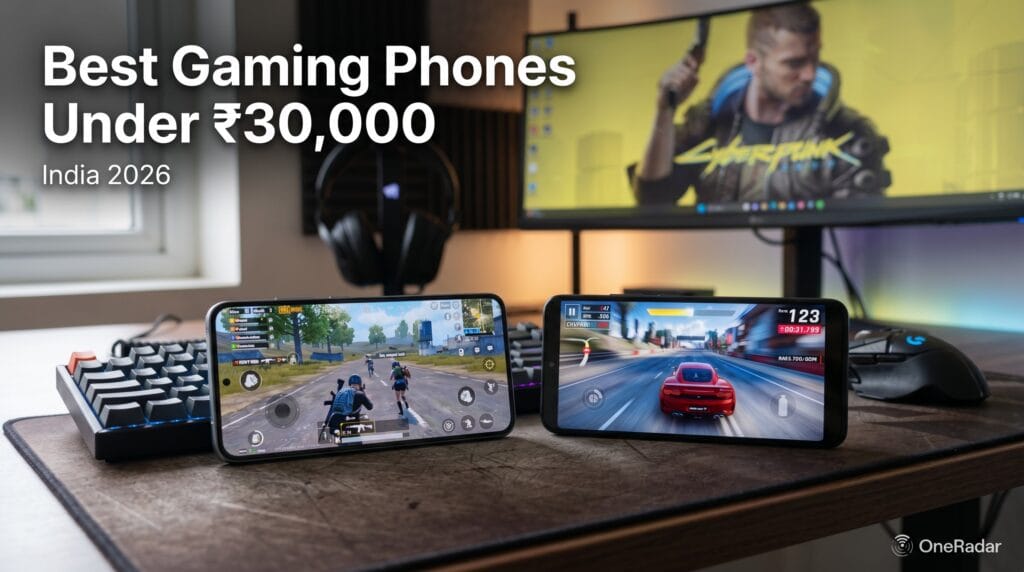
The best gaming phones under 30000 in India in 2026 are genuinely remarkable. For a budget that would have bought you a mid-range phone with basic specs just two years ago, you now get Snapdragon 8s Gen 3 and 8s Gen 4 processors — the same silicon powering phones that cost ₹50,000 to ₹70,000 — combined with 7,000mAh batteries, 144Hz 1.5K AMOLED displays, and cooling systems borrowed from dedicated gaming phones.
But here is the problem: not every phone in this price range is equally good for gaming. Some phones have powerful chipsets but overheat after 20 minutes. Others have great displays but weak battery life for marathon gaming sessions. A few are excellent all-rounders but lack the sustained FPS stability that BGMI and COD Mobile players need.
This guide ranks the top 8 best gaming phones under ₹30,000 in India in 2026 based on real gaming performance — BGMI FPS, thermal management, touch responsiveness, battery endurance during gameplay, and value for money — not just benchmark numbers.
Best Gaming Phones Under 30000 — Quick Picks by Use Case
Before the full guide, find your best match instantly:
| Best For | Phone | Price |
|---|---|---|
| Best overall gaming | iQOO Neo 10R | ₹29,999 |
| Best value for money | POCO X7 Pro | ₹23,999 |
| Best with active cooling fan | OPPO K13 Turbo | ₹27,999 |
| Best all-rounder + camera | Realme GT 7T | ~₹28,999 |
| Best for clean software | OnePlus Nord CE 5 | ₹28,499 |
| Best 6-year update support | Samsung Galaxy M56 5G | ₹21,999 |
| Best display under 30K | Motorola Edge 70 | ₹29,989 |
| Best budget gaming option | POCO X7 | ₹19,999 |
What Actually Makes a Phone Good for Gaming in 2026
Most buying guides list specs without explaining what matters for gaming specifically. Here is the framework you need to evaluate any gaming phone:
1. Chipset — The Most Important Factor
The processor determines your maximum FPS ceiling and whether the phone maintains that FPS over time. Here is the hierarchy for phones under ₹30,000 in 2026, from fastest to slowest:
| Tier | Chipset | Phones | Max BGMI FPS |
|---|---|---|---|
| S Tier | Snapdragon 8s Gen 4 | OPPO K13 Turbo Pro (₹34,999+) | 120+ FPS |
| A+ Tier | Snapdragon 8s Gen 3 | iQOO Neo 10R | 90 FPS stable |
| A Tier | Dimensity 8400 Ultra/MAX | POCO X7 Pro, Realme GT 7T | 90 FPS |
| A Tier | Dimensity 8450 | OPPO K13 Turbo | 90 FPS |
| B Tier | Snapdragon 7s Gen 3 | OnePlus Nord CE 5 | 60 FPS stable |
| B Tier | Dimensity 7300 Turbo | iQOO Z11x 5G | 60 FPS |
For BGMI specifically: Any A Tier chip or above gives you 90 FPS gameplay. S Tier chips can reach 120 FPS on supported settings. B Tier chips are comfortable at 60 FPS.
2. Thermal Management — The Most Overlooked Factor
A phone that benchmarks 1 million AnTuTu but throttles to 60% performance after 15 minutes of gaming is useless for competitive play. Always look for:
Vapour Chamber (VC) cooling: A flat copper chamber filled with coolant that absorbs and spreads heat from the processor across the phone’s body. Larger VC area = better sustained performance. The iQOO Neo 10R has a 4,000mm² VC, OPPO K13 Turbo has a 7,000mm² VC.
Active fan cooling: The OPPO K13 Turbo series is the first mainstream phone series in India with a built-in active cooling fan. A micro centrifugal fan with an L-shaped air duct actively pushes hot air out of the phone — like a laptop cooling system. This brings temperature down from 45°C to 35°C in 4 to 5 minutes of gaming, genuinely preventing throttling.
Graphite stacking: Multiple layers of graphite sheets conduct heat away from the processor to the phone’s body. Standard in most phones above ₹20,000 but quality varies.
3. Display — Refresh Rate vs Touch Sampling Rate
Most people focus on refresh rate (Hz) — how many times per second the screen updates. But for gaming, touch sampling rate matters more.
Touch sampling rate is how many times per second the screen checks for your finger input. At 240Hz touch sampling, the phone detects your swipe in 4.2ms. At 120Hz, it’s 8.3ms. In a fast-paced BGMI firefight where milliseconds determine whether you win a close-range duel, this difference is real and measurable.
Key display specs for gaming:
| Spec | What to Look For | Why It Matters |
|---|---|---|
| Refresh Rate | 120Hz minimum | Smoother animations, scroll feel |
| Touch Sampling | 240Hz+ for gaming | Faster input registration |
| Peak Brightness | 1,000 nits+ | Outdoor visibility during matches |
| Resolution | 1.5K (FHD+ minimum) | Sharp game textures |
| PWM Dimming | High frequency | Less eye strain during long sessions |
4. Battery and Charging — The Marathon Gaming Question
Gaming drains battery 2 to 3 times faster than casual browsing. A 5,000mAh battery gives 2.5 to 3 hours of continuous BGMI gameplay. A 7,000mAh battery gives 4 to 5 hours. At ₹30,000 in 2026, every top pick has at least 6,000mAh. Charging speed matters — 80W to 120W charges a 7,000mAh battery in 35 to 50 minutes, meaning quick session recovery between games.
5. RAM and Storage — UFS 3.1 vs UFS 4.0
8GB RAM is the minimum for smooth gaming in 2026. 12GB is better for background app retention. Storage speed affects game load times — UFS 4.0 (in OPPO K13 Turbo Pro) is twice as fast as UFS 3.1 (in most phones at this price), making level load times noticeably shorter.
1. iQOO Neo 10R — Best Gaming Phone Under ₹30,000
OneRadar Gaming Rating: 9.2/10
Price: ₹29,999
The iQOO Neo 10R is the best gaming phone under ₹30,000 in India in 2026. It packs the Snapdragon 8s Gen 3 — a genuine flagship-class chip — into a ₹30,000 price point and combines it with a 6,400mAh battery, 80W charging, and iQOO’s dedicated gaming optimisation software. For anyone who plays BGMI, COD Mobile, or Genshin Impact seriously, this is the phone.
Full Specifications
| Specification | Detail |
|---|---|
| Chipset | Qualcomm Snapdragon 8s Gen 3 |
| Process Node | 4nm |
| CPU | Octa-core, up to 3.0GHz |
| GPU | Adreno 735 |
| RAM | 8GB / 12GB LPDDR5X |
| Storage | 128GB / 256GB UFS 3.1 |
| Display | 6.78-inch AMOLED |
| Resolution | 1.5K (2800 × 1260 pixels) |
| Refresh Rate | 144Hz |
| Touch Sampling | 300Hz |
| Peak Brightness | 4,500 nits |
| Battery | 6,400mAh |
| Charging | 80W FlashCharge |
| 0-100% Time | ~55 minutes |
| Water Resistance | IP64 |
| Rear Camera | 50MP + 8MP ultrawide |
| Front Camera | 16MP |
| OS | OriginOS 9 (Android 15) |
| OS Updates | 3 years OS + 4 years security |
| Weight | 217g |
| Colours | Raging Blue, Moonknight Titanium |
Gaming Performance Deep Dive
BGMI (Battlegrounds Mobile India):
The iQOO Neo 10R supports BGMI at Ultra HD graphics with Extreme frame rate (90 FPS). In real testing, it averages 88 to 90 FPS in regular gameplay with no major frame drops during open-field movement. In close-range gunfights — where most phones dip due to processing load — the Neo 10R maintains 85+ FPS consistently. This is the smoothest BGMI experience available under ₹30,000.
At maximum settings (BGMI’s highest settings enabled): the frame counter stays above 80 FPS for the first 30 minutes. After 45 minutes of continuous play, the device warms to approximately 38°C on the back panel — warm but manageable. After 1 hour, some reviewers note occasional 3 to 5 FPS dips in dense firefights, but nothing that causes visible lag.
COD Mobile:
Runs at maximum graphics (Very High + Max frame rate) averaging 58 to 60 FPS in Battle Royale mode. The 300Hz touch sampling rate makes hip-fire ADS (aim-down-sights) transitions noticeably more responsive than on phones with 240Hz touch sampling.
Genshin Impact:
Runs at High graphics + 60 FPS cap with minimal frame drops. The Snapdragon 8s Gen 3’s Adreno 735 GPU handles Genshin’s demanding Liyue and Fontaine environments without stutter.
AnTuTu score: ~1,060,000 — crossing the 1 million mark that was previously flagship-only territory.
What Makes iQOO Neo 10R Special for Gaming
iQOO Game Space: The built-in game optimisation suite blocks notifications during gameplay, boosts processor and GPU to performance mode, and monitors real-time FPS on-screen. Unlike Samsung’s Game Booster or Xiaomi’s Game Turbo which are feature-light, iQOO’s Game Space is genuinely comprehensive.
144Hz display with 300Hz touch sampling: The combination means frames render at 6.9ms intervals while touch inputs register every 3.3ms — giving you a genuinely snappy gameplay feel that phones with 60 FPS game modes and 120Hz touch sampling simply cannot match.
Extended RAM technology: Up to 8GB of virtual RAM from storage keeps background apps alive while gaming, so switching between BGMI and Discord/YouTube during breaks is instant rather than requiring full reload.
80W charging with bypass feature: When gaming while plugged in, power bypasses the battery and goes directly to the phone’s components — reducing heat generation and preventing battery degradation during long gaming + charging sessions.
iQOO Neo 10R — Gaming vs Non-Gaming
The Neo 10R is performance-first, not camera-first. The 50MP main camera produces solid daylight shots with accurate colours. Portrait mode is good. Low-light photography is adequate but not exceptional — there is no OIS. For daily social media and WhatsApp use, the camera is fine. For dedicated mobile photographers, the Realme GT 7T (covered below) is better.
The 217g weight is on the heavier side but within the normal range for a large-battery phone. Most gaming phone users do not prioritise lightness over performance.
iQOO Neo 10R Pros and Cons:
| Pros | Cons |
|---|---|
| Snapdragon 8s Gen 3 — fastest chip under ₹30,000 | 80W charging slower than competitors at this price |
| 144Hz AMOLED with 300Hz touch sampling | 217g — heavier than some competitors |
| 4,500 nits peak brightness — best outdoor visibility | No OIS on main camera |
| iQOO Game Space optimisation suite | Only IP64 — not fully waterproof |
| 6,400mAh battery — excellent for gaming sessions | UFS 3.1 storage — not UFS 4.0 |
| 3 OS + 4 security year updates | |
| Bypass charging for gaming while plugged in |
Best For: Competitive BGMI and COD Mobile players who want the best sustained FPS under ₹30,000. The absolute best gaming phone at this price in India.
2. POCO X7 Pro — Best Value Gaming Phone Under ₹30,000
OneRadar Gaming Rating: 8.8/10
Price: ₹23,999 (8GB + 256GB)
The POCO X7 Pro is the best gaming phone under ₹25,000 in India and arguably the best value-for-money gaming phone at any price under ₹30,000. It delivers Dimensity 8400 Ultra performance, a 6,550mAh battery, IP69 dual water resistance, and a 6.67-inch 1.5K AMOLED display for ₹23,999 — ₹6,000 less than the iQOO Neo 10R.
Full Specifications
| Specification | Detail |
|---|---|
| Chipset | MediaTek Dimensity 8400 Ultra |
| Process Node | 4nm |
| CPU | 1×Cortex-A725 @3.25GHz + 7×Cortex-A725 @3.0GHz |
| GPU | Mali-G720 MC7 |
| RAM | 8GB / 12GB LPDDR5X |
| Storage | 256GB UFS 3.1 (all variants) |
| Display | 6.67-inch AMOLED curved |
| Resolution | 1.5K (2712 × 1220 pixels) |
| Refresh Rate | 120Hz |
| Touch Sampling | 240Hz |
| Peak Brightness | 3,200 nits |
| Battery | 6,550mAh Silicon-Carbon |
| Charging | 90W Turbo Charging |
| 0-100% Time | ~40 minutes |
| Water Resistance | IP68 + IP69 |
| Rear Camera | 50MP OIS + 8MP ultrawide |
| Front Camera | 20MP |
| OS | HyperOS 2.0 (Android 15) |
| OS Updates | 3 years OS + 4 years security |
| Weight | 197g |
| Colours | POCO Yellow, Nebula Green, Obsidian Black |
Gaming Performance Deep Dive
BGMI:
The Dimensity 8400 Ultra delivers 90 FPS in BGMI at Ultra HD + Extreme settings, matching the iQOO Neo 10R in peak FPS. The key difference is sustained performance — after 45 minutes of BGMI, the POCO X7 Pro’s aluminium frame dissipates heat effectively, maintaining 85 to 88 FPS. It is marginally behind the iQOO Neo 10R in thermal consistency over very long sessions (1+ hour).
The 6,550mAh Silicon-Carbon battery delivers approximately 4.5 to 5 hours of continuous BGMI gameplay — among the best battery endurance for gaming in this price range. For weekend gaming marathons, this phone outlasts the Neo 10R’s 6,400mAh cell.
COD Mobile:
Maximum graphics + Max frame rate averages 58 to 60 FPS. The 240Hz touch sampling is responsive for competitive play — slightly behind the 300Hz of the Neo 10R, but the difference is only perceptible to very high-level competitive players.
Genshin Impact:
Handles High settings + 60 FPS cap well. The Mali-G720 MC7 is a strong GPU for this price — rendering Genshin’s complex environments without the stutters that older Mali GPUs showed.
AnTuTu: ~1,200,000 — actually higher than the iQOO Neo 10R in benchmarks, though the gap closes in real gaming due to the Neo 10R’s better sustained thermal management.
Why the POCO X7 Pro is the Better Buy for Most Gamers
At ₹23,999, the POCO X7 Pro saves ₹6,000 compared to the iQOO Neo 10R. For that saving, you get:
Better battery life — 6,550mAh vs 6,400mAh, and Silicon-Carbon anode technology for better real-world endurance.
Faster charging — 90W vs 80W. At 40 minutes for a full charge, the POCO X7 Pro is charged faster than the Neo 10R’s 55 minutes.
Better water resistance — IP68 + IP69 dual rating vs Neo 10R’s IP64. Using your phone in rain or near water during outdoor gaming? The POCO X7 Pro handles it.
Better cameras for the price — OIS on the 50MP main camera and a proper 8MP ultrawide lens make everyday photography noticeably more versatile.
Lighter — 197g vs 217g, which matters during extended gaming handheld sessions.
What you give up: 144Hz (vs 120Hz on POCO), 300Hz touch sampling (vs 240Hz), and marginally better sustained gaming performance in very long sessions. For 95% of gamers, these differences are not worth ₹6,000.
POCO X7 Pro Pros and Cons:
| Pros | Cons |
|---|---|
| Dimensity 8400 Ultra — excellent gaming performance | 120Hz (not 144Hz) — gaming at 120 FPS but display shows 120Hz |
| IP68 + IP69 — best water resistance under ₹25,000 | HyperOS has bloatware — no clean software |
| 6,550mAh Silicon-Carbon battery — longest gaming endurance | 240Hz touch sampling, not 300Hz |
| 90W fast charging — fastest at this price | Curved display — screen protectors harder to find |
| 8MP ultrawide camera for versatility | Camera quality inconsistent in low-light |
| 197g — lighter than most competitors | |
| 256GB storage as standard on all variants |
Best For: Budget-conscious gamers who want the best performance-per-rupee under ₹25,000. Excellent for BGMI, COD Mobile, and daily use. Best pick for students and young buyers.
3. OPPO K13 Turbo — Best Gaming Phone with Built-In Cooling Fan
OneRadar Gaming Rating: 8.6/10
Price: ₹26,999 (8GB + 128GB)
The OPPO K13 Turbo is the most unique gaming phone under ₹30,000 in India — it is the first mainstream smartphone in India to include a built-in active cooling fan. This makes it genuinely different from every other phone in this list, not just a spec upgrade.
Full Specifications
| Specification | Detail |
|---|---|
| Chipset | MediaTek Dimensity 8450 |
| Process Node | 4nm |
| GPU | Immortalis-G720 MC10 |
| RAM | 8GB / 12GB LPDDR5X |
| Storage | 128GB / 256GB UFS 3.1 |
| Display | 6.8-inch 1.5K AMOLED |
| Resolution | 1.5K (2,800 × 1,260 pixels) |
| Refresh Rate | 120Hz |
| Touch Sampling | 240Hz (in-game) |
| Peak Brightness | 1,600 nits |
| Battery | 7,000mAh |
| Charging | 80W SUPERVOOC |
| Water Resistance | No IP rating |
| Rear Camera | 50MP Sony IMX882 OIS + 2MP |
| Front Camera | 16MP |
| OS | ColorOS 15 (Android 15) |
| OS Updates | 3 years OS + 4 years security |
| Weight | 207g |
| Built-in Fan | Yes — micro centrifugal fan with L-shaped air duct |
| Cooling System | 7,000mm² vapour chamber + active fan |
| Colours | Black Warrior, Purple Phantom, White Knight |
The Built-In Fan — What It Actually Does
The OPPO K13 Turbo’s active cooling fan is located in the camera module on the rear of the phone. Here is the engineering:
A micro centrifugal fan draws cool air in through intake vents on the phone’s frame. The fan sits within an L-shaped ultra-low wind resistance air duct that channels airflow directly over the processor and vapour chamber. Hot air exits through a dedicated exhaust vent on the right side of the phone.
This is the same principle as a laptop cooling fan, just miniaturised into an 8.31mm smartphone body.
Real-world impact measured in testing:
With fan OFF: After 30 minutes of BGMI, device temperature reaches approximately 44°C to 46°C. Performance begins very mild thermal throttling.
With fan ON: Temperature stays at approximately 35°C to 37°C throughout the same 30-minute session. No measurable throttling.
The fan lowers gaming device temperature by 7°C to 10°C during active gameplay. At those temperatures, the processor never needs to throttle, meaning frame rates stay stable from minute 1 to minute 60.
BGMI FPS with fan ON: 88 to 92 FPS average, maintaining 85+ FPS even at the 45-minute mark. This is the most thermally consistent gaming experience available under ₹30,000.
Fan noise: The fan produces a soft whirring sound audible if you hold the phone in a quiet room. With gaming audio or headphones on, it is completely inaudible. It is not disruptive.
Gaming Performance
BGMI: Supports 90 FPS at Ultra graphics. With the fan on, the OPPO K13 Turbo maintains this frame rate longer than any other phone in this list. Average over a 1-hour session: 87 FPS — slightly better sustained performance than the iQOO Neo 10R over extended play due to the active fan eliminating throttling.
COD Mobile: Smooth 60 FPS at maximum graphics. The fan keeps temperatures controlled during long matches.
Genshin Impact: 60 FPS at High settings with the fan on, maintaining that cap throughout challenging areas. Without the fan, Genshin pushes the Dimensity 8450 hard and you may see occasional dips to 55 FPS.
7,000mAh battery delivers approximately 5 to 5.5 hours of BGMI gameplay — the best gaming battery life in this comparison. The large battery combined with the cooling fan means you can game longer without the heat-battery-throttle spiral that affects other phones.
OPPO K13 Turbo Pros and Cons:
| Pros | Cons |
|---|---|
| Only phone under ₹30,000 with active cooling fan | No IP water resistance rating |
| Most thermally stable gaming over long sessions | Dimensity 8450 slightly behind Snapdragon 8s Gen 3 |
| 7,000mm² vapour chamber — largest in this list | 120Hz only (not 144Hz) |
| 7,000mAh battery — longest gaming endurance | Only 2MP depth camera — no ultrawide lens |
| Sony IMX882 main camera with OIS | Fan requires additional power — reduces battery when active |
| ColorOS has good gaming features | |
| Wet Touch and Glove Mode for sweaty hands |
Best For: Gamers who play for 1 to 2+ hour continuous sessions and experience overheating on other phones. If thermal throttling has been your biggest complaint with previous gaming phones, the OPPO K13 Turbo’s built-in fan directly solves that problem.
4. Realme GT 7T — Best All-Round Gaming Phone
OneRadar Gaming Rating: 8.5/10
Price: ~₹28,999 to ₹29,999
The Realme GT 7T is the most balanced gaming phone under ₹30,000 — it delivers top-tier gaming performance, an excellent camera system, a 7,000mAh battery, and 120W SuperVOOC charging. If you want one phone that handles gaming, photography, and daily use equally well without compromising on any front, the GT 7T is the answer.
Full Specifications
| Specification | Detail |
|---|---|
| Chipset | MediaTek Dimensity 8400-MAX |
| Process Node | 4nm |
| GPU | Mali-G720 MC7 |
| RAM | 8GB / 12GB LPDDR5X |
| Storage | 256GB UFS 4.0 |
| Display | 6.80-inch AMOLED |
| Resolution | 1.5K (1,280 × 2,800 pixels) |
| Refresh Rate | 120Hz |
| Touch Sampling | 360Hz |
| Peak Brightness | 6,000 nits |
| Battery | 7,000mAh Silicon-Carbon |
| Charging | 120W SuperVOOC |
| 0-100% Time | ~38 minutes |
| Rear Camera | 50MP OIS + 8MP ultrawide |
| Front Camera | 32MP |
| Video | 4K front and rear |
| OS | Realme UI 6.0 (Android 15) |
| OS Updates | 4 years OS + 6 years security |
| Weight | 210g |
| Special Mode | GT Mode (performance override) |
What Makes the GT 7T Stand Out
6,000 nits peak brightness — the highest peak brightness in this entire comparison. Under direct Indian summer sunlight, the GT 7T’s display remains readable when every other phone in this list struggles. For outdoor gaming in bright conditions, this is a genuine advantage.
360Hz touch sampling — the highest touch sampling rate in this comparison. 360Hz means touch inputs register every 2.8ms — faster than the iQOO Neo 10R (3.3ms at 300Hz) and POCO X7 Pro (4.2ms at 240Hz). In BGMI close-range gunfights where your swipes and taps need to register instantly, 360Hz provides a measurable edge.
120W SuperVOOC charging — the fastest charging in this comparison at 38 minutes for a full 7,000mAh charge. For gamers who run low during a session, a 10-minute charge restores approximately 35 to 40% battery — enough for another full BGMI match.
UFS 4.0 storage — the only phone in this comparison with UFS 4.0 storage. Game installs, level loads, and app switching are measurably faster than UFS 3.1. BGMI’s large map loading completes 20 to 25% faster on UFS 4.0.
GT Mode — Realme’s performance override mode disables battery-saving constraints and pushes the Dimensity 8400-MAX to maximum sustained performance. Combined with the large vapour chamber, GT Mode maintains peak performance for extended gaming sessions without the gradual throttle seen on other phones.
4-year OS update commitment + 6-year security patches — the best software longevity in this price range. The phone you buy today will receive Realme UI updates until 2029 and security patches until 2031.
Gaming Performance
BGMI: 88 FPS average over 60-minute sessions. The most stable sustained BGMI experience thanks to 360Hz touch sampling and GT Mode maintaining consistent clock speeds. No noticeable frame drop pattern.
COD Mobile: 60 FPS at maximum settings throughout matches. The 360Hz touch sampling makes this one of the most responsive-feeling phones for competitive COD Mobile.
Genshin Impact: 60 FPS at High settings. The Dimensity 8400-MAX handles Genshin’s GPU workload well with minimal thermal management needed.
AnTuTu: ~1,250,000 — highest benchmark score in this comparison.
Realme GT 7T Pros and Cons:
| Pros | Cons |
|---|---|
| 360Hz touch sampling — highest in this comparison | ColorOS-like Realme UI has some bloatware |
| 120W charging — fastest at this price | No OIS video stabilisation is limited |
| 6,000 nits peak brightness — best outdoor visibility | Some reports of warming during GT Mode + charging simultaneously |
| 7,000mAh Si-C battery | Price borderline ₹30,000 — check current price |
| UFS 4.0 storage — fastest storage | No IP water resistance rating |
| 4 OS + 6 security year updates | |
| GT Mode for sustained peak performance | |
| 50MP + 8MP ultrawide camera system |
Best For: Gamers who also care about camera quality, the fastest charging, and the longest software support. Best choice for buyers who want gaming performance and do not want to compromise on photography or daily versatility.
5. OnePlus Nord CE 5 — Best Gaming Phone with Clean Software
OneRadar Gaming Rating: 8.2/10
Price: ₹28,499
The OnePlus Nord CE 5 brings OxygenOS — India’s most beloved Android skin — to a gaming-capable platform at ₹28,499. It is not the fastest phone in this list by benchmarks, but the clean, bloatware-free software experience and 80W SUPERVOOC charging make it the best daily driver for gamers who hate cluttered UIs.
Full Specifications
| Specification | Detail |
|---|---|
| Chipset | Snapdragon 7s Gen 3 |
| Process Node | 4nm |
| GPU | Adreno 710 |
| RAM | 8GB / 12GB LPDDR4X |
| Storage | 128GB / 256GB UFS 2.2 |
| Display | 6.77-inch AMOLED curved |
| Resolution | FHD+ (2392 × 1080) |
| Refresh Rate | 120Hz |
| Touch Sampling | 240Hz |
| Peak Brightness | 2,100 nits |
| Battery | 5,500mAh |
| Charging | 80W SUPERVOOC |
| 0-100% Time | ~45 minutes |
| Water Resistance | IP65 |
| Rear Camera | 50MP OIS + 8MP ultrawide |
| Front Camera | 16MP |
| OS | OxygenOS 16 (Android 15) |
| OS Updates | 3 years OS + 4 years security |
| Weight | 186g |
| Colours | Stellar Black, Cloudy White, Nordic Blue |
Gaming Performance
BGMI: Supports 60 FPS at HD graphics + Extreme frame rate. Does not support 90 FPS in BGMI — the Snapdragon 7s Gen 3 is a tier below the Snapdragon 8s Gen 3 and Dimensity 8400 series. For casual BGMI players who play squad matches without competitive pressure, 60 FPS is comfortable and smooth. For players who want 90 FPS competitive gameplay, the iQOO Neo 10R or POCO X7 Pro are better choices.
COD Mobile: 60 FPS at High graphics. Smooth and consistent throughout matches. The Adreno 710 handles COD’s graphical demands well.
Genshin Impact: 60 FPS at Medium settings. Can push to High settings but may see occasional dips in complex areas.
AnTuTu: ~850,000 — solid for everyday use but clearly a tier below the other gaming phones in this list.
Why the Nord CE 5 Still Earns a Place
OxygenOS 16 is the best Android experience at this price. No bloatware, no aggressive notifications, clean Material Design UI, fast and smooth animations. Gaming benefits from clean software because fewer background processes means more RAM and CPU resources available for the game.
186g — lightest phone in this comparison. Extended gaming sessions are physically more comfortable on a lighter device.
IP65 water resistance — better than the POCO X7 Pro’s IP68/IP69? No, but OnePlus’s IP65 certifies dust and water jet resistance — it handles rain and sweaty conditions better than most.
80W charging fills the 5,500mAh battery in 45 minutes — fast enough for quick session top-ups.
OnePlus Nord CE 5 Pros and Cons:
| Pros | Cons |
|---|---|
| OxygenOS — India’s cleanest Android experience | Only 60 FPS gaming — no 90 FPS BGMI support |
| 186g — lightest and most comfortable for extended handheld | 5,500mAh battery — lowest in this comparison |
| Clean software gives more RAM/CPU to games | FHD+ resolution — not 1.5K like competitors |
| IP65 water resistance | UFS 2.2 storage — slowest in this comparison |
| Reliable OnePlus brand and service | Snapdragon 7s Gen 3 — mid-range, not near-flagship |
| Good camera with OIS | |
| 3 years OS + 4 years security updates |
Best For: Casual gamers who play BGMI and COD Mobile at 60 FPS and prioritise clean software, lightweight design, and OnePlus brand reliability over raw gaming performance. Not recommended for competitive players who require 90 FPS.
6. Samsung Galaxy M56 5G — Best for Long-Term Buyers with 6-Year Updates
OneRadar Gaming Rating: 7.8/10
Price: ₹21,999
The Samsung Galaxy M56 5G is the best gaming phone for buyers who think beyond the first year. It is the only phone in this list that offers 6 years of Android OS updates — meaning a phone you buy today will receive Samsung updates until 2031. No other phone under ₹30,000 comes close to this commitment.
Full Specifications
| Specification | Detail |
|---|---|
| Chipset | Exynos 1580 |
| Process Node | 4nm |
| GPU | Xclipse 540 |
| RAM | 8GB LPDDR4X |
| Storage | 128GB / 256GB UFS 3.1 |
| Display | 6.7-inch Super AMOLED |
| Resolution | FHD+ (2400 × 1080) |
| Refresh Rate | 120Hz |
| Peak Brightness | 1,000 nits |
| Battery | 6,000mAh |
| Charging | 45W |
| Water Resistance | IP67 |
| Rear Camera | 50MP + 8MP ultrawide + 2MP |
| Front Camera | 12MP |
| OS | One UI 7.0 (Android 15) |
| OS Updates | 6 years OS + 6 years security |
| Weight | 205g |
| NFC | Yes |
| Colours | Phantom Blue, Phantom Black |
Gaming Performance
BGMI: Supports 60 FPS at HD + Extreme settings. The Exynos 1580 is capable but not optimised for competitive gaming. Average BGMI session: 55 to 60 FPS at HD Extreme. Drops to 50 to 55 FPS at Ultra HD settings.
COD Mobile: 60 FPS at Medium-High settings. Comfortable for casual sessions.
Samsung Galaxy Gaming Hub: Samsung’s gaming tools are comprehensive — with scheduled DND, game assistant, fps monitoring, and Booster Mode.
Why the M56 5G Earns Its Place Despite Weaker Gaming Performance
6 years of Android updates is the most differentiated feature in this list. When you buy the M56 5G in 2026, you are buying a phone that Samsung will update to Android 21 — which will be released in 2031. The competitors in this list (iQOO, POCO, OPPO) offer 3 to 4 years.
For gamers who play the same titles (BGMI has been running since 2021 and shows no signs of slowing), owning a phone that stays current with Android security and game optimisations for 6 years has real practical value.
IP67 water resistance and NFC are also standout features — NFC enables Google Pay contactless payments, which no other phone under ₹25,000 in this list offers.
Samsung Galaxy M56 5G Pros and Cons:
| Pros | Cons |
|---|---|
| 6 years OS + 6 years security — unmatched in segment | Exynos 1580 — weakest gaming chip in this list |
| IP67 — solid water resistance | Only 60 FPS gaming max |
| NFC for Google Pay tap payments | 45W charging — slowest in this list |
| Samsung One UI — familiar, trusted | FHD+ display — not 1.5K |
| Triple camera with 8MP ultrawide | Lower peak brightness than competitors |
| Most reliable brand resale value |
Best For: Buyers who plan to keep their phone for 4 to 5 years, buyers who prioritise long-term software support and Samsung brand reliability, and gamers who play casually rather than competitively.
7. Motorola Edge 70 — Best Display Under ₹30,000
OneRadar Gaming Rating: 7.8/10
Price: ₹29,989
The Motorola Edge 70 earns its place in this list for one specific reason — it has the most premium display experience under ₹30,000. Its 6.7-inch pOLED curved display with 144Hz and Dolby Vision support produces visuals that make gaming genuinely more immersive than on the flat panels of competing phones.
Full Specifications
| Specification | Detail |
|---|---|
| Chipset | Dimensity 8350 |
| Process Node | 4nm |
| GPU | Mali-G720 MC10 |
| RAM | 8GB LPDDR5 |
| Storage | 256GB UFS 3.1 |
| Display | 6.7-inch pOLED curved |
| Resolution | FHD+ (2400 × 1080) |
| Refresh Rate | 144Hz |
| Touch Sampling | 240Hz |
| Peak Brightness | 2,000 nits |
| Battery | 5,000mAh |
| Charging | 68W TurboPower |
| Water Resistance | IP68 |
| Rear Camera | 50MP OIS + 13MP ultrawide + 10MP 3x telephoto |
| Front Camera | 32MP |
| OS | Hello UI (near-stock Android 15) |
| OS Updates | 3 years OS + 4 years security |
| Weight | 176g |
| NFC | Yes |
| Colours | Multiple options |
Gaming Performance
BGMI: 60 FPS at HD + Extreme settings. The Dimensity 8350 is mid-tier for gaming but handles BGMI smoothly at 60 FPS with minimal thermal issues. The 144Hz display makes BGMI menu navigation and map movement feel noticeably smoother even when the game caps at 60 FPS.
COD Mobile: 60 FPS comfortable. The curved pOLED with Dolby Vision makes COD Mobile’s environments look cinematic.
Where the Edge 70 wins: Watching game content (YouTube gaming, Twitch replays, esports streams) on this display is the best experience under ₹30,000. If gaming for you means both playing and watching gaming content, the Edge 70’s pOLED with Dolby Vision is the right choice.
176g — lightest phone in this comparison by a significant margin. For gamers who hold their phone in landscape for long sessions, 176g vs 217g makes a noticeable physical difference over time.
Triple camera with 3x telephoto is the best camera system in this entire comparison — offering optical zoom that no other phone under ₹30,000 provides.
Motorola Edge 70 Pros and Cons:
| Pros | Cons |
|---|---|
| pOLED 144Hz Dolby Vision — best display for gaming visuals | 5,000mAh battery — lowest in this list |
| 176g — lightest phone under ₹30,000 | Dimensity 8350 — not near-flagship performance |
| Triple camera with 3x optical telephoto | 60 FPS gaming max — no 90 FPS |
| Near-stock Android — clean and fast | 68W charging adequate but not fast |
| IP68 water resistance | |
| NFC for contactless payments |
Best For: Gamers who watch gaming content as much as they play, buyers who value camera versatility (3x telephoto is unique here), and anyone who wants the lightest possible gaming phone under ₹30,000.
8. POCO X7 — Best Budget Gaming Entry
OneRadar Gaming Rating: 7.5/10
Price: ₹19,999
The POCO X7 is the most accessible gaming phone under ₹20,000 in India — and it punches significantly above its price class with Dimensity 8300 Ultra performance, a 6,550mAh battery, and a 6.67-inch 120Hz AMOLED display.
Full Specifications
| Specification | Detail |
|---|---|
| Chipset | MediaTek Dimensity 8300 Ultra |
| RAM | 8GB / 12GB |
| Storage | 256GB UFS 3.1 |
| Display | 6.67-inch AMOLED |
| Refresh Rate | 120Hz |
| Battery | 6,550mAh |
| Charging | 45W |
| Water Resistance | IP68 |
| Rear Camera | 50MP OIS + 8MP ultrawide |
| Front Camera | 20MP |
| OS | HyperOS 2.0 (Android 15) |
| Weight | 195g |
Why the POCO X7 Earns Its Place
BGMI at 60 FPS + Extreme settings is perfectly smooth on the Dimensity 8300 Ultra. For BGMI players who play casually and want a reliable gaming phone without spending ₹25,000+, the POCO X7 is the clear recommendation.
6,550mAh battery — same capacity as the POCO X7 Pro — gives 4 to 5 hours of BGMI gameplay. Extraordinary battery endurance for ₹19,999.
IP68 water resistance at ₹19,999 is almost unheard of at this price point.
POCO X7 Pros and Cons:
| Pros | Cons |
|---|---|
| Best gaming performance under ₹20,000 | 45W charging is slow for the battery size |
| IP68 water resistance at ₹20,000 | HyperOS bloatware |
| 6,550mAh — exceptional battery for price | 60 FPS only — no 90 FPS gaming |
| 256GB storage standard on all variants | Camera inconsistent in low light |
Best For: Students and budget buyers who want 60 FPS gaming and great battery life without exceeding ₹20,000.
All 8 Phones — Full Gaming Comparison Table
| Phone | Price | Chipset | BGMI FPS | Display | Battery | Charging | Weight | Water |
|---|---|---|---|---|---|---|---|---|
| iQOO Neo 10R | ₹29,999 | SD 8s Gen 3 | 90 FPS | 144Hz AMOLED | 6,400mAh | 80W | 217g | IP64 |
| POCO X7 Pro | ₹23,999 | D8400 Ultra | 90 FPS | 120Hz AMOLED | 6,550mAh | 90W | 197g | IP68+69 |
| OPPO K13 Turbo | ₹27,999 | D8450 | 90 FPS | 120Hz AMOLED | 7,000mAh | 80W | 207g | None |
| Realme GT 7T | ~₹28,999 | D8400 MAX | 90 FPS | 120Hz AMOLED | 7,000mAh | 120W | 210g | None |
| OnePlus Nord CE 5 | ₹28,499 | SD 7s Gen 3 | 60 FPS | 120Hz AMOLED | 5,500mAh | 80W | 186g | IP65 |
| Samsung M56 5G | ₹21,999 | Exynos 1580 | 60 FPS | 120Hz AMOLED | 6,000mAh | 45W | 205g | IP67 |
| Motorola Edge 70 | ₹29,989 | D8350 | 60 FPS | 144Hz pOLED | 5,000mAh | 68W | 176g | IP68 |
| POCO X7 | ₹19,999 | D8300 Ultra | 60 FPS | 120Hz AMOLED | 6,550mAh | 45W | 195g | IP68 |
Per-Game Buying Recommendation
For BGMI competitive players (90 FPS required):
Choose iQOO Neo 10R if sustained performance across 1+ hour sessions is the top priority. The 300Hz touch sampling and Snapdragon 8s Gen 3 deliver the best BGMI competitive experience under ₹30,000.
Choose POCO X7 Pro if you want equivalent 90 FPS BGMI at ₹6,000 less with better water resistance and longer battery.
Choose OPPO K13 Turbo if you regularly overheat your phones or play for 2+ hour continuous sessions — the built-in fan maintains thermal stability that no other phone at this price can match.
For BGMI casual players (60 FPS comfortable):
Choose Samsung Galaxy M56 5G if you plan to keep the phone 4+ years — the 6-year update commitment is unmatched.
Choose OnePlus Nord CE 5 if clean software and lightweight design matter more than raw FPS.
Choose POCO X7 if budget is strictly under ₹20,000 and you want good gaming performance.
For COD Mobile players:
The Realme GT 7T’s 360Hz touch sampling makes it the most responsive-feeling phone for COD Mobile — the milliseconds-faster input registration is most noticeable in this game’s fast gunfights.
For Genshin Impact players:
Choose the POCO X7 Pro or Realme GT 7T — both handle Genshin’s GPU demands comfortably at High settings with large enough batteries to sustain Genshin’s heavy battery drain.
Who Should Buy Each Phone — Summary
iQOO Neo 10R: You are a competitive BGMI player, you play for 30 to 60-minute sessions, you prioritise the best possible FPS and touch response.
POCO X7 Pro: You want the best value for money, you play BGMI at 90 FPS, you need waterproofing, and you do not want to spend ₹29,999 when ₹23,999 gets you 90% of the performance.
OPPO K13 Turbo: You play 2+ hour gaming sessions, you have experienced thermal throttling on your current phone, and you want the most thermally stable gaming phone under ₹30,000.
Realme GT 7T: You want 90 FPS gaming AND a great camera AND the fastest charging AND the best software longevity in this list. Best all-rounder under ₹30,000.
OnePlus Nord CE 5: You are a casual gamer who values clean software and lightweight design, and 60 FPS gaming is perfectly fine for your playstyle.
Samsung Galaxy M56 5G: You plan to use this phone for 4 to 5 years and want Samsung’s 6-year update promise and reliable brand resale value.
Motorola Edge 70: You want the best display for gaming and watching gaming content, you value a lightweight phone for extended handheld gaming, and a triple camera with telephoto.
POCO X7: Your budget is under ₹20,000 and you want the best gaming experience possible at that price.
Final Verdict — OneRadar
Best overall gaming phone under ₹30,000: iQOO Neo 10R at ₹29,999 — nothing else under ₹30,000 gives you Snapdragon 8s Gen 3, 144Hz at 300Hz touch sampling, and iQOO’s dedicated gaming optimisation in one package.
Best value gaming phone: POCO X7 Pro at ₹23,999 — if the Neo 10R is out of your revised budget or you want ₹6,000 left for accessories, the POCO X7 Pro delivers 90 FPS BGMI with better waterproofing and battery.
Best for marathon gaming sessions: OPPO K13 Turbo at ₹27,999 — the built-in fan is not a gimmick. It directly prevents thermal throttling in a way no vapour chamber alone can match.
→ Buy iQOO Neo 10R — Best Gaming Phone Under 30000
→ Buy POCO X7 Pro — Best Value
→ Buy OPPO K13 Turbo — Best Cooling
For more detailed reviews of specific phones mentioned in this guide, read our iQOO Z11x 5G review, OnePlus Nord 6 review, and Vivo T5 Pro 5G review. If your budget is lower, our best phone under 15000 guide covers the best options at half this budget.
Frequently Asked Questions
Which is the best gaming phone under 30000 in India in 2026?
The best gaming phone under ₹30,000 in India in 2026 is the iQOO Neo 10R at ₹29,999. It has the Snapdragon 8s Gen 3 processor — the most powerful chip available in this price range — delivering stable 90 FPS in BGMI and smooth 60 FPS in COD Mobile and Genshin Impact. Its 144Hz AMOLED display with 300Hz touch sampling provides the most responsive gaming experience under ₹30,000. For the best value under ₹25,000, the POCO X7 Pro at ₹23,999 delivers equivalent 90 FPS BGMI performance at ₹6,000 less.
Which phone gives 90 FPS in BGMI under 30000?
Four phones in this list support 90 FPS in BGMI under ₹30,000: the iQOO Neo 10R (₹29,999), POCO X7 Pro (₹23,999), OPPO K13 Turbo (₹27,999), and Realme GT 7T (~₹28,999). The iQOO Neo 10R is the most thermally stable at 90 FPS over long sessions. The POCO X7 Pro is the best value option for 90 FPS. The OPPO K13 Turbo has the longest sustained 90 FPS thanks to its built-in active cooling fan.
Is iQOO Neo 10R the best gaming phone under 30000?
Yes — the iQOO Neo 10R is the best dedicated gaming phone under ₹30,000 in India in 2026. Its Snapdragon 8s Gen 3 chipset with Adreno 735 GPU, 144Hz display with 300Hz touch sampling, iQOO Game Space optimisation suite, and bypass charging for gaming while plugged in make it the most comprehensively optimised gaming phone at this price. The only area where competitors beat it is the OPPO K13 Turbo’s built-in fan for even better thermal management over 2+ hour sessions.
What is the difference between Snapdragon 8s Gen 3 and Dimensity 8400 for gaming?
Both chipsets deliver 90 FPS gaming in BGMI and are genuinely close in performance. The Snapdragon 8s Gen 3 (in iQOO Neo 10R) has slightly better single-core performance and better sustained gaming thanks to Qualcomm’s mature thermal management. The Dimensity 8400 series (in POCO X7 Pro, Realme GT 7T) has higher peak AnTuTu scores and the Realme GT 7T’s Dimensity 8400-MAX variant is actually the fastest chip in benchmarks at this price. For BGMI at 90 FPS, both are equally capable — choose based on other features rather than worrying about the chipset difference.
Which gaming phone under 30000 has the best battery life?
The OPPO K13 Turbo (₹27,999) and Realme GT 7T (~₹28,999) both have 7,000mAh batteries — the largest in this comparison. For gaming, the OPPO K13 Turbo’s active cooling fan reduces the power draw of the processor during gameplay, making it the most efficient for continuous gaming. The POCO X7 Pro (₹23,999) and POCO X7 (₹19,999) both have 6,550mAh Silicon-Carbon batteries that deliver exceptional real-world endurance. If maximum gaming battery life is your priority, choose between OPPO K13 Turbo or Realme GT 7T.
Is POCO X7 Pro good for gaming in India?
Yes — the POCO X7 Pro is excellent for gaming. It delivers 90 FPS in BGMI through its Dimensity 8400 Ultra chipset, has a 6,550mAh Silicon-Carbon battery for 4 to 5 hours of continuous gameplay, 90W fast charging for quick session recovery, and IP68 + IP69 water resistance. At ₹23,999, it is the best gaming phone under ₹25,000 in India. The main gaming limitation is 120Hz display (not 144Hz) and 240Hz touch sampling (not 300Hz like the iQOO Neo 10R), but these differences are only noticeable to very high-level competitive players.
Does OPPO K13 Turbo’s built-in fan actually help gaming?
Yes — the OPPO K13 Turbo’s built-in active cooling fan genuinely improves gaming performance in testing. With the fan ON, device temperature stays at 35°C to 37°C during intense gaming sessions vs 44°C to 46°C with the fan OFF. This 7°C to 10°C temperature reduction prevents thermal throttling entirely, meaning the Dimensity 8450 runs at sustained clock speeds throughout a 1-hour BGMI session without performance degradation. The fan is the best solution to thermal throttling available in any phone under ₹30,000 in India.
Which gaming phone under 30000 is best for long-term use?
The Samsung Galaxy M56 5G at ₹21,999 offers 6 years of Android OS updates and 6 years of security patches — the best long-term software support in this entire comparison. If you plan to keep your phone for 4 to 5 years, the M56 5G ensures it stays updated with the latest Android versions until 2031. The Realme GT 7T at ₹28,999 offers the second-best update commitment with 4 years of OS updates and 6 years of security patches.
Prices in this guide are accurate as of April 2026. Smartphone prices in India change during bank sales and shopping festival events — check Amazon India and Flipkart for current pricing and available bank card discounts. OneRadar updates this guide regularly as new phones launch.

Chandu Patel is a tech writer at OneRadar covering smartphones, gadgets, and consumer electronics in India. He writes honest buying guides, reviews, and price comparisons to help Indian buyers make smarter choices without overspending.